Current Biology 16, 1-6, May 23, 2006 ©2006 Elsevier Ltd All rights reserved DOI 10.1016/j.cub.2006.03.063
Supplemental Data
Phenotypically Linked Dichotomy in Sea Turtle Foraging Requires Multiple Conservation Approaches
Lucy A. Hawkes,1 Annette C. Broderick,1 Michael S. Coyne,2 Matthew H. Godfrey,3 Luis-Felipe Lopez-Jurado,4 Pedro Lopez-Suarez,4 Sonia Elys Merino,5 Nuria Varo-Cruz,4 and Brendan J. Godley1,*
1Marine Turtle Research Group,
Centre for Ecology and Conservation,
University of Exeter,
Cornwall Campus,
Penryn TR10 9EZ,
United Kingdom
2Marine Geospatial Ecology Lab,
Nicholas School of the Environment and Earth Sciences,
Duke University,
A321 LSRC, Box 90328,
Durham, North Carolina 27708-0328
3North Carolina Wildlife Resources Commission,
1507 Ann Street,
Beaufort, North Carolina 28516
4Universidad Las Palmas de Gran Canaria,
Departamento de Biología,
35017 Las Palmas de Gran Canaria
5Instituto Nacional de Desenvolvimento das Pescas,
C.P. 132,
Mindelo, Sao Vicente,
Islas de Cabo Verde
*Correspondence: bgodley@seaturtle.org
- index -
Figure S2. Map of MODIS aqua chlorophyll α productivity in the North Atlantic Ocean.
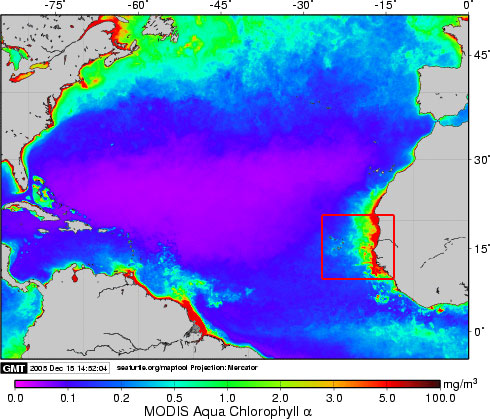
The region utilised by the turtles (outlined by the box) is one of the most productive areas of the tropical Atlantic. (Mean data for 2004; colour scale bar details chlorophyll concentration in mg.m-3).