seaturtle.org :
MTN :
ARCHIVES :
Sign In
Marine Turtle Newsletter 101:14-16, © 2003

Incidental Capture of Loggerhead Turtles (Caretta caretta) on Boa Vista (Cape Verde Islands)
L.F. López-Jurado, N. Varo-Cruz & P. López-Suárez
Biology Department. University of Las Palmas. 35017 Las Palmas. Canary Islands, Spain
(Email: llopez@dbio.ulpgc.es)
The sea is one of the major natural resources of the Cape Verde Islands, a small archipelago located 500 kilometers off the coast of Senegal (West Africa). This country consists of ten main islands and several islets, and possesses an Exclusive Economical Zone (EEZ) of about 734 square kilometers and a coastal perimeter of nearly 2000 kilometers. The marine shelf, whose limit is the 200 m isobath, is particularly extensive on the island of Boa Vista (Figure 1). It is likely that most of the loggerhead turtles (Caretta caretta) that breed in this archipelago are concentrated on this island (López-Jurado et al., 1999).
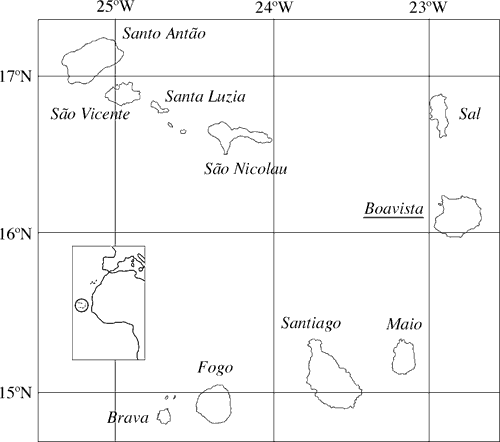
Figure 1. Map of Cape Verde Islands.
All commercial trawling is strictly forbidden by the legislation of the Cape Verde Islands. Experimental trawling is permitted only with the authorization of the governmental organizations (Decree law No. 17/18 and 97/87) such as the National Institute of Fishery Development and the General Direction of Fisheries (Ministry of Agriculture and Environment). However, Cape Verde is a developing country where effective control in natural resource extraction is difficult to enforce. Frequently, foreign trawlers intrude upon the EEZ in the insular shelf, particularly in Boa Vista, to catch demersal fish species (General Marine and Harbor Director, pers. comm.).
Incidental capture in trawls is a well-known cause of mortality for sea turtles and have been reported all over the world (Eckert 1995; Hillestad et al. 1995; Lutcavage et al. 1997; Márquez 2000; Oravetz 1999; Pascual 1985; Seidal et al. 1995). Nevertheless, there are few illustrated examples, especially when massive incidental capture occurs. Here, we graphically report on the significant ecological damage caused by a trawl net in proximity of a turtle nesting colony at the beginning of the breeding season (see front cover of this issue).
On the 15th of June 2001 (at the beginning of the breeding season), a piece of a trawl net 20 m in length and 3 m in width was found on the shore of the island of Boa Vista (As Gatas Bay: 16º 12’ N – 22º 42’ W). Ten loggerhead turtles were found entangled in this net. The animals were measured (Curved Carapace Length CCL, Curved Carapace Width CCW) and sexed using tail length as an index (Table 1). Two nurse sharks, Ginglymostoma cirratum and one tope shark, Galeorhinus galeus, were also present in the net. Two female turtles and the tope shark were dead. The live turtles showed abrasions in different areas of their carapaces, skin and cephalic scales, apparently due to the friction from the net. We cannot be certain if the animals were victims of ghost fishing or whether some or all of the animals were captured and then discarded with the net.
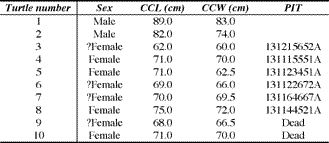
Table 1. ID number, Sex (F: female, M: male), Curved Carapace Length (CCL), Curved Carapace Width (CCW) and PIT number of the entangled loggerhead turtles.
Six live turtles (except both males) were PIT-tagged (Avid©) and all live turtles and sharks were subsequently released together. Four of the individuals had CCL measuring less than the smallest turtle (71.0 CCL) observed nesting on Boa Vista in the preceding 4 nesting seasons (Table 2). Thus we were not able to definitively assign sex, although we suspect all were female due to short tail length. Specimens 9 and 10 were autopsied but no developed eggs were found. The stomach was empty in one specimen and in the other several unidentified fish remains were found.
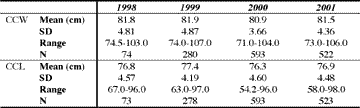
Table 2. Mean curved carapace length (CCL) and curved carapace width (CCW) of nesting females from Boa Vista Island over a 4-year study period (1998–2001).
We have no information on the origin of the net, but because most animals were still alive when it was found, we suspect that their entanglement was relatively recent. It is important to note that males were encountered and that their CCL were greater than those of the females entangled. There is a popular belief in the Cape Verde Islands that the consumption of sea turtle meat, and especially the penis of the male, gives people sexual vigor. Because of this belief, males are selectively hunted by free diving in most of the islands (Cabrera et al., 1999). However, there are currently insufficient data to assess the influence of sex-specific turtle captures on the sex ratio of the breeding population.
CABRERA, I., D. CEJUDO & L.F. LÓPEZ-JURADO. 1999. Human predation on marine turtles in the archipelago of Cape Verde, western Africa. In: H. Kalb & T. Wibbels (compilers), Proceedings of the 19th Annual Symposium on Sea Turtle Conservation and Biology. NOAA-TM-NMFS-SEFSC-443, pp. 217.
ECKERT, K.L. Anthropogenic threats to Sea Turtles. 1995. In: K.A. Bjorndal (Ed.). Biology and Conservation of Sea Turtles. Revised edition. Smithsonian Institute Press, Washington D.C. pp. 611-612
HILLESTARD, H.O., J.I. RICHARDSON, C. MCVEA & J.M.WATSON. 1995. Worldwide incidental capture of sea turtles. 1995. In: K.A. Bjorndal (Ed.). Biology and Conservation of Sea Turtles. Revised edition. Smithsonian Institute Press, Washington D.C. pp. 489-495.
LÓPEZ-JURADO, L.F., I. CABRERA, D. CEJUDO, C. EVORA & P. ALFAMA 1999. Distribution of marine turtles in the archipelago of Cape Verde, Western Africa. In: H. Kalb & T. Wibbels (compilers), Proceedings of the 19th Annual Symposium on Sea Turtle Conservation and Biology. NOAA-TM-NMFS-SEFSC-443, pp. 245-247.
LUTCAVAGE, M.E., P. PLOTKIN, B. WITHERINGTON & P. L. LUTZ. 1997. Human impacts on sea turtle survival. In: P.L. Lutz & J.A. Musick (Ed.). The Biology of Sea Turtles. CRC Marine Science Series. CRC Press, Boca Raton, USA. pp 387-409.
MÁRQUEZ, R. 2000. Las tortugas marinas y nuestro tiempo. Second edition. La ciencia para todos / 144. Impresora y Ecuadernación Progreso, S.A. México, D.F. 198 pp.
ORAVETZ, C.A. 1999. Reducing incidental catch in fisheries. In: K.L. Eckert, K.A. Bjorndal, F.A. Abreu-Grobois, M. Donelly (Ed). Research and Management Techniques for the Conservation of sea Turtles. IUCN/SSC Marine Turtle Specialist Group Publication No 4. pp. 189-193.
PASCUAL, X. 1985. Contribución al estudio de las tortugas marinas en las costas españolas. I. Distribución. Misc. Zool. 9: 287-294.
SEIDEL, W.R. & C. MCVEA. 1995. Development of a sea turtle excluder shrimp trawl for the southeast U.S. penaeid shrimp fishery. 1995. In: K.A. Bjorndal (Ed.). Biology and Conservation of Sea Turtles. Revised edition. Smithsonian Institute Press, Washington, USA. pp. 497-502.