seaturtle.org :
MTN :
ARCHIVES :
Sign In
Marine Turtle Newsletter 101:16-18, © 2003

Observations on Sea Turtles in the State of Paraíba, Brazil
Rita Mascarenhas1, Douglas Zeppelini Filho1,2 & Valdi Silva Moreira1
1Associação Guajiru: Ciência –Educação e Meio Ambiente, Randal Cavalcante Pimentel No. 40, Bessa, João Pessoa, Paraíba, 58035-380 Brazil (E-mail: quelonia@ig.com.br; rita.mascarenhas@lycos.com)
2Departamento de Sistemática e Ecologia- Centro de Ciências Exatas e da Natureza, Universidade Federal da Paraíba. Campus I, Cidade Universitária João Pessoa, Paraíba, 58059-900 Brazil (E-mail: zeppelin@dse.ufpb.br)
Five species of marine turtle commonly occur on feeding and breeding grounds in Brazil, and the majority of regular nest monitoring efforts on the continental coast is concentrated on beaches stretching from the state of Sergipe south to the state of Rio de Janeiro (Marcovaldi & Marcovaldi 1999). Although organized monitoring has historically targeted the areas where turtles seem to be more numerous in Brazil, there is the possibility that turtles nest in lesser numbers elsewhere. Here we report sea turtle occurrences in the state of Paraíba, in northeastern Brazil.
We focused our monitoring on a narrow belt of seashore 1,800 m in length, named Mar do Macaco (in the municipality of Intermares) (7°S 34°W). This area bounded by the Jaguaribe river in the south and Ponta de Campina in the north, is in between the cities of João Pessoa and Cabedelo. The northern and southern extremes of this beach are also bounded by two coral reefs, clearly delimiting the sandy zone available for nesting turtles. The beach is backed by many residential and commercial buildings, and Intermares has a population of about 7,000 people. The local population and a variable number of tourists use the beach for many purposes, including surfing, jogging, fishing, and swimming, among others. Both cars and horses are regularly found on the beach, and at night artificial lighting from buildings and streets illuminates much of the beach.
We monitored this beach from December 2001 through August 2002 with the aid of volunteers. The protocols for fieldwork were modified from a Projeto TAMAR manual (unpublished). To organize the monitoring staff and to make their work easier, the nesting beach was divided in two halves: to the left of the “Bar do Surfista”(LSBS) and to the right of the “Bar do Surfista” (RSBS). The monitoring consisted of daily early morning surveys to count all tracks before the tide and beach users effaced them. Nests were confirmed by verifying the presence of eggs. Each nest was marked with a unique number and 4 wooden stakes enclosed by a plastic mesh net (about 50cm high) that encompassed about 5m2 area around the nest. The idea was to keep animals, people and cars from trampling on the nest, and also to hold the hatchlings after emergence so they could be safely released closer to the sea. This was necessary because of the photo pollution (artificial lighting) along the seashore.
We recorded 64 hawksbill (Eretmochelys imbricata) nesting crawls, of which 58 were actual nests and 6 were “false crawls” (Table 1). Eleven nests were disturbed and their eggs stolen, while the 47 remaining nests hatched successfully. Of these 47 nests, 6 were not found until after emergence, when some of their hatchlings (a total of 220) were found the following morning concentrated under a streetlight.
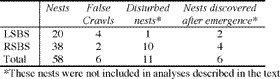
Table 1. Hawksbill nests observed in the state of Paraiba, Brazil 2002.
A total of 5,492 eggs were laid within the 41 nests that were followed from laying to emergence, giving an average of 133.9 eggs/nest. Of these, a total of 4,395 live hatchlings were produced (80% overall hatching success rate, range for individual nests = 11.5% - 98.6%), while 172 dead hatchlings and 925 unhatched eggs were encountered in the nests upon post-emergence excavation.
The nesting season of the larger hawksbill population found in Bahia, Brazil runs from October until March (Marcovaldi et al. 1999). In Paraíba, the latest nest observed was laid on June 3 and emerged on August 15, 2002. Note that some nests could have been laid before the monitoring work started, although local fishermen report that the earliest observed nests historically have occurred in the second half of December. The peak of nesting is concentrated in February and March. The peak of nesting of hawksbills in Bahia, Brazil, is January/February, which suggests that these two nesting populations are not closely linked.
During the nesting season, we also had the opportunity to observe an adult male leatherback that had been accidentally captured by a small fishing boat on 03 April 2002 and brought to Acaú in the southern end of Paraíba. This turtle was covered by epifauna and was missing part of its right front flipper, although the wound appeared well healed. The curved carapace length was 160 cm and the curved carapace width was 106 cm. This turtle was released offshore soon after the measurements were taken. Although regular nesting of leatherbacks occurs in the southern part of Brazil (Barata & Fabiano 2002), there are relatively few at-sea observations of this species in Brazil (Sampaio 1999).
We also observed 32 dead stranded green turtles (Chelonia mydas) between March and November 2002 in the area between Cabo Branco in João Pessoa and Mar do Macaco, Cabedelo. All animals were measured, dissected and buried above the high tide line. The smallest turtle was 34.9 cm and the biggest was 104 cm in curved carapace length. The necropsies revealed different suspected causes of death, including drowning, intoxication and disease.
These observations of sea turtles in Paraíba suggest that expanded monitoring effort here would be a worthwhile conservation activity. This is particularly true in Mar do Macaco in Paraíba, because it is an urbanized beach with all the attendant impacts on sea turtles. As a result, we have created the non-governmental association called “Associação Guajiru: ciência – educação – meio ambiente” (Guajiru Association: Science, Education, and Environment), with the main objective to develop research in environmental conservation and education, with a focus on sea turtles and other marine and littoral fauna.
Acknowledgements We thank the biology students of the Federal University of Paraíba (Pablo Riul, Robson G. dos Santos, André S. dos Santos, Ana C. G. P. Falcão, Stenphenson Abrantes, MS Elaine Elloy), the marathon runner José A. Nóbrega, and the journalist Germana Bronzeado for the volunteer field work; the Fauna department of IBAMA/PB and Jeremy and Diana Jeffers for kindly providing photos, and also Alice Grossman for providing the TAMAR protocols. The manuscript benefited from the comments of two referees.
Barata, P.C.R. & F.F.C. Fabiano. 2002. Evidence for leatherback sea turtle (Dermochelys coriacea) nesting in Arraial do Cabo, state of Rio de Janeiro, and a review of occasional leatherback nests in Brazil. Marine Turtle Newsletter 96:13-16.
Marcovaldi, M. Â. & G. G. Marcovaldi. 1999. Marine turtles of Brazil: the history and structure of Projeto TAMAR-IBAMA. Biological Conservation 91:35-41.
Marcovaldi, M.Â., C.F. Vieitas & M.H. Godfrey. 1999. Nesting and conservation management of hawksbill turtles (Eretmochelys imbricata) in northern Bahia, Brazil. Chelonian Conservation and Biology 3:301-307.
Sampaio, C.L.S. 1999. Dermochelys coriacea (Leatherback sea turtle), accidental capture. Herpetological Review 30:38-39.