seaturtle.org :
MTN :
ARCHIVES :
Sign In
Marine Turtle Newsletter 101:18-20, © 2003

Epibiotic Associates of Oceanic-Stage Loggerhead Turtles from the Southeastern North Atlantic
Michael G. Frick1, Arnold Ross2, Kristina L. Williams1, Alan B. Bolten3, Karen A. Bjorndal3 & Helen R. Martins4
1Caretta Research Project, P.O. Box 9841, Savannah, Georgia 31412 USA. (E-mail: caretta05@aol.com)
2Scripps Institution of Oceanography, Marine Biology Research Division, La Jolla, California 92093-0202, USA, (E-mail: arross@att.net)
3Archie Carr Center for Sea Turtle Research and Department of Zoology, University of Florida, P.O. Box 118525, Gainesville, Florida 32611, USA
4Department of Oceanography and Fisheries, University of the Azores, PT-9901-862 Horta, Azores, Portugal
Upon leaving rookery beaches in the southeastern USA, post-hatchling loggerhead turtles (Caretta caretta) migrate to oceanic developmental habitats in the waters of the eastern North Atlantic (Bolten et al. 1993; 1998; Carr 1986). Because of its proximity to the eastern edge of the North Atlantic Gyre, local sea floor topography and seasonal meteorological events, this area provides rich foraging habitats for juvenile loggerhead turtles and a variety of other oceanic organisms (Bjorndal 1997; Brongersma 1972; Carr 1986; Coston-Clements et al. 1991; Davenport 1992; Pouchet & de Guerne 1886; Van Nierop & Den Hartog 1984). Young turtles spend at least 6 years in these oceanic developmental habitats before recruiting to neritic habitats in the western North Atlantic (Bjorndal et al. 2000). During the oceanic stage, juvenile loggerheads are exposed to a wide variety of small organisms that rely upon flotsam for survival. As a result, juvenile loggerheads are often colonized by several commensal forms. The first available information on the epibionts of loggerhead sea turtles from the southeastern North Atlantic Ocean is apparently Tuckey’s (1818) report of pedunculate barnacles Lepas anatifera and L. membranacea (=Conchoderma virgatum) from sea turtles (‘Testudo caretta’) near the Azores. Here, we tabulate a list of the epibionts associated with oceanic-stage loggerhead turtles from the southeastern North Atlantic Ocean. We present new records of epibiotic forms from oceanic-stage loggerheads from the Azores.
Turtles were captured in dipnets while floating at the surface in the waters around the Azores from March – November, 1986 -1994 (n = 17). The curved carapace length (CCL) of each turtle was recorded as the distance from the anterior edge of the nuchal notch to the posterior notch between the supracaudals (minimum mid-line CCL range= 14.6 – 62.1 cm; mean= 33.7). Epibionts were removed from turtles and preserved in either 70 % ethyl alcohol or 10 % formalin, depending upon preservative availability. Samples were placed in 500-ml polyethylene wide-mouthed bottles and labeled with the corresponding tag numbers of the host turtle. Specimens were later sorted and identified to the lowest taxon possible. Because sampling efforts for epibiota were not standardized and not all captured turtles were surveyed for epibiota, we are not able to provide information on the frequency of occurrence or density of any particular epibiont species. Nor should our list of epibionts be considered as complete for oceanic-stage loggerheads in the southeastern North Atlantic.
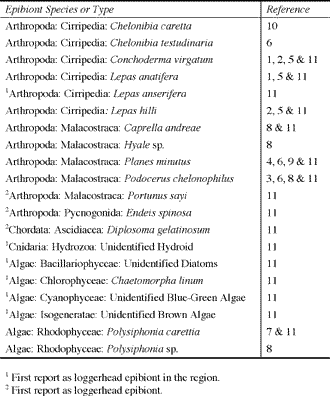
Table 1. Epibionts associated with oceanic-stage loggerhead turtles from the southeastern North Atlantic. References: 1Tuckey (1818), 2Darwin (1852), 3Chevreux & de Guerne (1888), 4Milne-Edwards & Bouvier (1899), 5Gruvel (1920), 6Davenport (1994), 7Rojas-Gonzalez et al. (1994), 8Moore (1995), 9Dellinger et al. (1997), 10Southward (1998), 11present study.
To our knowledge, at least 20 epibiont species or types are present on oceanic-stage loggerhead turtles in the southeast North Atlantic (Table 1), 9 of which were previously unknown as epibionts from turtles in this region prior to our study. Ours is also the first report of gulf-weed swimming crabs (Portunus sayi), sea spiders (Endeis spinosa) and pelagic tunicates (Diplosoma gelatinosum) as epibionts of loggerhead turtles. The occurrence of P. sayi as an epibiont of Caretta is interesting because no other portunid crab has ever been reported as an epibiont of sea turtles. However, P. sayi, as well as a number of the epibionts listed herein, are commonly associated with floating Sargassum weed and it is not surprising that these species can exist as epibiotic associates of oceanic-stage Caretta as well (see Coston-Clements et al. 1991). Future studies will undoubtedly yield new records of epibionts associated with oceanic-stage loggerheads. Quantitative studies of the epibiota of oceanic turtles would be particularly valuable. Additionally, epibiont studies are needed from sea turtle developmental areas outside of the southeastern North Atlantic and the epibionts associated with all sea turtle species that have an oceanic life stage need documentation.
Acknowledgements: We thank Jo and Greta Franck of the Shanghai and Jonathan Gordon of the Song of the Whale (owned and operated by International Fund for Animal Welfare) for their assistance in capturing loggerheads in the waters of the Azores. Research in the Azores was supported by the US National Marine Fisheries Service. Leandro Bugoni and an anonymous reviewer provided helpful comments to improve the manuscript.
BJORNDAL, K. A. 1997. Foraging ecology and nutrition of sea turtles. In: P.L. Lutz and J.A. Musick (Eds.). The Biology of Sea Turtles. CRC Press, Boca Raton. pp. 199-231.
BJORNDAL, K. A., A. B. BOLTEN & H. R. MARTINS. 2000. Somatic growth model of juvenile loggerhead sea turtles Caretta caretta: duration of the pelagic stage. Marine Ecology Progress Series 202: 265-272.
BOLTEN, A. B., H. R. MARTINS, K. A. BJORNDAL & J. GORDON. 1993. Size frequency distribution of pelagic-stage loggerhead sea turtles (Caretta caretta) in the waters around the Azores and Madeira. Arquipelago 11A: 49-54.
BOLTEN, A. B., K. A. BJORNDAL, H. R. MARTINS, T. DELLINGER, M. J. BISCOITO, S. E. ENCALADA & B. W. BOWEN. 1998. Transatlantic developmental migrations of loggerhead sea turtles demonstrated by mtDNA sequence analysis. Ecological Applications 8: 1-7.
BRONGERSMA, L. D. 1972. European Atlantic turtles. Zoologische Verhandelingen, Leiden 121: 1-318.
CARR, A. 1986. New perspectives on the pelagic stage of sea turtle development. NOAA Technical Memorandum NMFS-SEFC-190, 36 pp.
CHEVREUX, E. & J. DE GUERNE. 1888. Sur un amphipode nouveau (Cyrtophium chelonophilium), commensal de Thalassochelys caretta L. Comptes Rendus Acad. Sci. Paris 88: 1-4.
COSTON-CLEMENTS, L., L. R. SETTLE, D. E. HOSS & F. A. CROSS. 1991. Utilization of the Sargassum habitat by marine invertebrates and vertebrates – a review. NOAA Technical Memorandum NMFS-SEFSC-296, 32 pp.
DARWIN, C. 1852. A monograph on the sub-class Cirripedia, with figures of all the species. The Lepadidae; or, pedunculated cirripedes. Royal Society, London, 400 pp.
DAVENPORT, J. 1992. Observations on the ecology, behaviour, swimming mechanism and energetics of the neustonic grapsid crab, Planes minutus. Journal of the Marine Biological Association of the United Kingdom 72: 611-620.
DAVENPORT, J. 1994. A cleaning association between the oceanic crab Planes minutus and the loggerhead sea turtle Caretta caretta. Journal of the Marine Biological Association of the United Kingdom 74: 735-737.
DELLINGER, T., J. DAVENPORT & P. WIRTZ. 1997. Comparison of social structure of Columbus crabs living on loggerhead sea turtles and inanimate flotsam. Journal of the Marine Biological Association of the United Kingdom 77: 185-194.
GRUVEL, J. A. 1920. Cirrhipedes provenant des campagnes de S.A.S. le Prince de Monaco (1885 – 1913). Resultants des campagnes scientifiques accomplies sur son yacht par Albert Ier, Prince Souverain de Monaco. Monaco 53: 1-88.
MILNE-EDWARDS, A. & E. L. BOUVIER. 1899. Crustaces decapodes provenant de campagnes l’Hirondelle (supplement) et de la Princess-Alice (1891-1897). Res. Camp. Sci. Monaco 13: 1-106.
MOORE, P. G. 1995. Podocerus chelonophilus (Amphipoda: Podoceridae) associated with epidermal lesions of the loggerhead turtle, Caretta caretta (Chelonia). Journal of the Marine Biological Association of the United Kingdom 75: 253-255.
POUCHET, G. & J. DE GUERNE. 1886. Sur l’alimentation des tortues marines. Comptes Rendus Acad. Sci. Paris 102: 877-879.
ROJAS-GONZALEZ, B., J. ALFONSO-CARILLO & C. IBEAS. 1994. New records of Rhodomelaceae (Rhodophyta) from the Canary Islands. Bot. Mar. 37: 133-138.
SOUTHWARD, A. J. 1998. New observations on barnacles (Crustacea: Cirripedia) of the Azores region. Arquipelago. Life and Marine Sciences 16A: 11-27.
Tuckey, J. K. 1818. Narrative of an expedition to explore the river Zaire, usually called the Congo, in south Africa, in 1816, under the direction of Captain J. K. Tuckey, R. N. to which is added, the journal of Professor Smith; some general observations on the country and its inhabitants; and an appendix: containing the natural history of that part of the kingdom of Congo through which the Zaire flows. John Murray, London. 498 pp.
VAN NIEROP, M. M. & J. C. DEN HARTOG. 1984. A study on the gut contents of five juvenile loggerhead turtles, Caretta caretta (Linnaeus) (Reptilia, Cheloniidae), from the south-eastern part of the North Atlantic Ocean, with emphasis on coelenterate identification. Zoologische Mededelingen, Leiden 59: 35-54.