Marine Turtle Newsletter 20:6-8, © 1982

Release of captive-bred green sea turtles
J.R.Wood
Cayman Turtle Farm Ltd., P.O. Box 645, Grand Cayman, British West Indies
seaturtle.org : MTN : ARCHIVES : Sign In
Marine Turtle Newsletter 20:6-8, © 1982
J.R.Wood
Cayman Turtle Farm Ltd., P.O. Box 645, Grand Cayman, British West Indies
On 4 July 1980 100 yearling Atlantic ridleys (Lepidochelys kempi), raised during their first year at the National Marine Fisheries Service laboratory in Galveston, Texas, and returned to the care of the Instituto Nacional de Pesca, were transported by air from CanCun, Mexico to Grand Cayman. The turtles, property of the Mexican government, were to be raised at the facilities of Cayman Turtle Farm Ltd. as part of a cooperative program between the Insitituto Nacional de Pesca and Cayman Turtle Farm Ltd. The ultimate objective of the project being the establishment of a captive breeding herd of this highly endangered species.
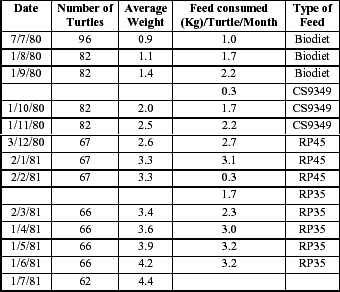
vTanks, water supply, and density: The turtles were maintained in concrete tanks 1.2m x 1.8m x .4m which were provided with approximately 15 litres/min of fresh, chlorinated (2ppm) sea water. During January through March the inflow water was heated to 30ºC. Tank floors were covered with .3cm thick solid rubber matting to reduce plastron lesions. Initial stocking density was 20 turtles/tank. In April 1981 the ridleys were transferred to 2 fiberglass tanks with a diameter of 3m and water depth of .4m. Water flow was 30 litres/min. Stocking density was 33 turtles/tank. Weighing and feed: The turtles were either individually or collectively weighed the first of each month. Average weights and the amount and type of feed consumed each month are given by Table 1. Biodiet, Bioproducts Inc., Warrenton, Oregon, is a semi-moist ration containing as fed 38% protein, 11.5% fat, 2.0% fiber and 22.5% moisture. CS9349 is a 45% protein, floating pelleted ration specially formulated by Central Soya, Ft. Wayne, Indiana, for sea turtles. RP45 and RP35 are floating turtle chows produced by Ralston Purina, St. Louis, Missouri, containing 45% and 35% protein respectively. Disease and mortality: Of the 38 mortalities which occurred during the year 17 were recorded during the first 10 days including 4 turtles which did not survive transport. Many of the turtles were found upon arrival to have carapace lesions consisting of brownish ulcerative pits particularly in association with the marginal scutes. Necropsy results indicated that other than carapace and skin lesions no gross abnormalities were associated with death. On 29 July 1980 treatment of these lesions was initiated by soaking the turtle overnight for 10 nights in a sea water solution containing approximately 82mg tetracycline/litre (Polyotic, American Cyanamid). This caused substantial healing. In February many of the turtles had skin lesions as a result of biting. These were treated by giving approximately 50mg tetracycline per kg of body weight. Feed was coated with a gelatin/tetracycline solution prior to feeding. A variety of bacteria were isolated from the carapace and skin lesions including Moraxelia sp., Citrobacter freundi, Pseudomonas putrifaciens, Pseudomonas cepacia, and Plesioyqonas shigelloides.Sex ratio and tags: Necropsy results show the sex ratio of males to females to be 1.4:1 (N=22) indicating that the remaining stock contains a reasonable number of females. It is perhaps also worth noting that the metal tags attached by the National Marine Fisheries Service to the inside trailing edge of the right front flipper are, with a single exception, still firmly in place.
Discussion: Growth and feed conversion efficiency of the Atlantic ridley in captivity is considerably less than that of the green sea turtle suggesting that either the natural growth rate is less or that the optimum ration is not being offered. By far the major problem with rearing these turtles in captivity is their natural aggressiveness which produces severe and sometimes fatal skin and shell lesions. Following the transfer of the turtles to the fiberglass tanks in April the number of turtles with skin lesions has been greatly reduced. This may reflect decrease in aggressive behaviour as they grow.
Table 1. Data on Atlantic Ridleys maintained in captivity at CTFL.
(Note: Because of the great interest in conservation of Kemp's ridley, the Editor encouraged the Cayman Farm to put the facts in the above article on record. It is hoped that a future issue of the Marine Turtle Newsletter will give fuller details of the Rancho Nuevo and Padre Island projects).