Marine Turtle Newsletter 37:1-3, © 1986

Harnessing Leatherbacks
S. A. Eckert and K. L. Eckert
Department of Zoology, University of Georgia, Athens, GA 30602 USA
seaturtle.org : MTN : ARCHIVES : Sign In
Marine Turtle Newsletter 37:1-3, © 1986
S. A. Eckert and K. L. Eckert
Department of Zoology, University of Georgia, Athens, GA 30602 USA
There is a paucity of information available on the behavior and physiology of sea turtles at sea , particularly when compared to the nesting data accumulated over recent decades. Although interest in such investigations is great, efforts continue to be inhibited by financial considerations, equipment limitations and restrictive monitoring opportunities.
In situ investigations require that instrumentation be mounted directly on a turtle for extended periods. This in turn requires that close attention be paid to instrument design and mounting. Any modification of the animal's behavior will, at the very least, bias the behavioral data obtained; at worst, the animal will be injured or killed. Recent interest in mounting remote tracking devices to free-swimming leatherback turtles, Dermochelys coriacea, compels us to share our experiences in this area. The purposes of this article are to describe a simple and effective harness design and to outline some avoidable problems.
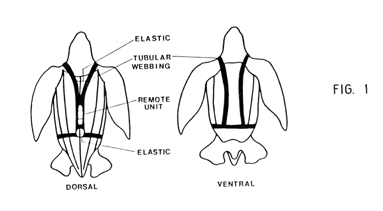
Leatherbacks are the largest, as well as the most morphologically and physiologically divergent, of the sea turtles. They migrate farther (Pritchard 1973), dive deeper (Eckert et al. 1986), and range into colder waters (Bleakney 1965; Lazell 1980) than do any other sea turtles. They are also the most difficult sea turtle upon which to secure equipment . The body and carapace are encased in soft, easily abraded skin, making it impossible to bolt equipment or tow lines directly to the carapace as with hard-shelled species (Hopkins & Murphy 1981; Timko & Kolz 1982). We resolved this dilemma by developing a harness that resembles a pair of suspenders (Fig. 1). It is a simpler design than that of Fretey (1984), primarily because our instrumentation was smaller than his. Regardless of complexity, a successful harness should meet 4 criteria:
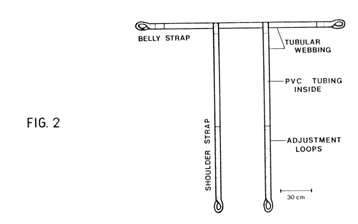
We found that 2.5 cm wide flat nylon or cotton webbing deeply incised the turtle's shoulders and scored the carapace. Chafing was eliminated by using 5 cm wide tubular nylon webbing and inserting 2.5 cm PVC ("clear flow" or "Tygon") tubing into the webbing of the shoulder straps (i.e., extending up and around the shoulders).
The belly (plastral) strap terminates in a 10 cm loop at each end and is inserted through distal loops in each shoulder strap (Fig. 1). Shoulder straps are then secured (sewn or riveted) to the belly strap 40 cm apart (Fig. 2). Leatherbacks nesting on St. Croix have worn the tubular strap harness for as long as 23 days with no sign of bleeding, chafing or loss of mobility. Fretey (1984) suggested coating buckles and straps with neoprene to protect the shell from chafing. Padding, particularly on buckles, is essential. Although we did not test neoprene rubber, we found neoprene wet suit sheeting and polypropelene foam to be unsatisfactory. Ambient pressures encountered during deep dives compressed these materials, rendering them useless as padding.
|
|
|
The harness is easily secured to a nesting female. During egg laying, a narrow tunnel is dug (by hand) beneath the turtle from one side to the other about 1/3 the way forward from the posterior end of the carapace. This placement takes advantage of the tapering shape of the body so that the harness will not slip forward once in place. [N.B. If tunnelling is initiated while the turtle is digging, her side-to-side motion will collapse your tunnel.]
Once the tunnel is completed, the belly strap is passed beneath the animal and the shoulder straps are passed forward, beneath the front flippers, and up and around the shoulders. The shoulder straps are brought back to meet the two free ends of the belly strap and all four ends (loops) are secured dorsally with multiple bands of 0.5 cm elastic cording. This single joining point simplifies installation and removal, permits easy tightening of the harness, allows control over the duration that the harness remains on the animal, and avoids the necessity for multiple buckles or attachment sites.
The elastic cording will disintegrate in time and release the turtle from the harness should the opportunity for removal not arise. If long-term retention is required, silicon rubber strapping may be substituted for the elastic cording. It is important that the harness be snug, but not constricting, and that the material used to join the straps:
Small instruments can be secured to the shoulder straps with screw-type hose clamps, or a D-ring may be secured and a tether attached. Larger units may require padding and additional design features such as buoyancy compensation (Fretey 1984). Tethered units should be equipped with release mechanisms in the event that the animal becomes ensnared. Equipment must be mounted securely on the strapping; substantial carapace damage has been observed when instruments (or clamps) were allowed to slap against the turtle during swimming. [N.B. this will also be a problem if the harness is too loose.] Equipment should be mounted dorsally, as opposed to laterally, to avoid compromising the turtle's bilateral symmetry and to avoid battering by the huge front flippers.
Finally, equipment must be designed to minimize modification of natural activity (e.g., streamlined) and to withstand the harsh conditions imposed by the normal activity cycles of the turtles. For example, radio tracking may be inhibited when leatherbacks spend more than 60% of their time submerged and surface only intermittently for short periods (Eckert et al. 1986). In addition, leatherbacks are known to dive as deep as 475m, (Eckert et al. 1986); such dives will expose attached instrumentation to ambient pressures exceeding 650 psi.
Information on long-distance movements, diel behavior and physiology of sea turtles at sea is conspicuously lacking. It is obvious that such information will be difficult to obtain due to the cost and uncertainty involved in developing new techniques for data gathering. As we begin to gather this important information, it is imperative that adequate consideration be given to the unique problems posed by free-swimming leatherbacks: the delicacy of their epidermis, their incessant activity, transoceanic migrations, short surface intervals, and the profound pressures encountered when they dive.
Bleakney, J. S. 1965. Reports of marine turtles from New England and eastern Canada. Can. F. Nat. 79:120-128.
Eckert, S. A., D. W. Nellis, K. L. Eckert and G. L. Kooyman. 1986. Diving patterns of two leatherback sea turtles (Dermochelys coriacea) during internesting intervals at Sandy Point, St. Croix, USVI. Herpetologica 42: in press.
Fretey, J. 1984. Tracking of leatherback turtles. ARCOS Newsletter. 7-11.
Hopkins, S. R. and T. M. Murphy. 1981. Reproductive ecology of Caretta caretta in South Carolina. Study Completion Report E-I, Study No. VI-A-I. South Carolina Wildlife and Marine Resources Department, Charleston, SC.
Lazell, J. D. 1980. New England waters: critical habitat for marine turtles. Copeia1980:290-295.
Pritchard, P. C. H. 1973. International migrations of South American sea turtles (Cheloniidea and Dermocheliidae). Anim. Beh. 21:18-27.
Timki, R. E. and A. L. Kolz. 1982. Satellite sea turtle tracking. Mar. Fish. Rev. 44(4):19-24.