Marine Turtle Newsletter 37:5-7, © 1986

Kemp's Decline: Special Alarm or General Concern?
Nat B. Frazer
Department of Biology, Mercer University, Macon, GA 31207 USA
seaturtle.org : MTN : ARCHIVES : Sign In
Marine Turtle Newsletter 37:5-7, © 1986
Nat B. Frazer
Department of Biology, Mercer University, Macon, GA 31207 USA
Woody (1986) called attention to the fact that the number of female Kemp's ridleys, Lepidochelys kempi, nesting at Rancho Nuevo has continued to decline in recent years. Aside from stating that the US Fish & Wildlife Service estimated a decline of approximately 30% between 1978 and 1985, no indication was given of the rate of decline or of the time remaining until extinction of the nesting population. The present work is intended to provide such estimates and to compare the rate of decline of Kemp's ridley with that of a threatened population of loggerhead sea turtles, Caretta caretta.
Using data presented by Woody (1986), I performed a linear regression using log N(X) as the dependent variable and time as the independent variable, where N(x) is the number of nesting females in coded year X (1978 = 1; 1979 = 2, ... 1985 = 8). The resulting regression line is shown in the figure on the next page:
Numbers of Kemp's ridleys nesting at Ranch Nuevo, 1978-1985
[Based on original data presented by Woody 1986, MTN 35:4-5]
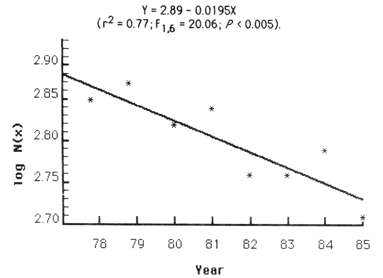
The regression line indicates that the nesting population is declining by about 4% per year (i.e., 10-0.0195 = 0.96) and that if it continues to decline at this rate, there will be only one nester appearing at Rancho Nuevo by 2125 AD. I recognize, of course, that extending a regression line far into the future is purely an academic exercise and that any population will have become functionally extinct long before it is reduced to one nesting female. Furthermore, extending the regression line back to the late 1940's yields a prediction (post-diction?) that there were only some 3,000 L. kempi nesting at Ranch Nuevo during those years. This is clearly in error if one accepts the conventional wisdom that there were ten times that many, based on the famous motion picture record taken at the time. There is also photographic evidence that there were still many hundreds of Kemp's ridleys nesting in the late 1960's (P. C. H. Pritchard, pers. comm.). Although I have not seen either of these photographic records, I am certainly willing to admit that the trends in recent years do not necessarily extend far into the past or future. However, the present rate of decline (4% per year) is certainly of interest, especially when compared to similar information available for another sea turtle species.
I recently provided a similar analysis for C. caretta (Frazer 1986) which indicated that the nesting population in Georgia (USA) is declining by some 3% per year (r2 = 0.2487; F1,15 = 4.97; P < 0.05). These results indicate that Kemp's ridley is not declining at a substantially faster rate than loggerheads, which are generally considered to be only "threatened" rather than "endangered." Kemp's ridley is unquestionably in more peril than the loggerhead, by virtue of its smaller numbers. However, the rate of decline itself does not indicate that L. kempi faces any special factors (i.e., trawlers, habitat destruction, etc.) that are not shared by other sea turtle species inhabiting the same waters. If there is a lesson here, it certainly is not that we should be unconcerned about L. kempi. Rather, I suspect that the real message is that "threatened" sea turtle species in some areas may be declining almost as fast and just as inexorably as are the "endangered" ones.
Frazer, N. B. 1986. Survival from egg to adulthood in a declining population of loggerhead turtles, Caretta caretta. Herpetologica 42(1):47-55.
Woody, J. B. 1986. Kemp's ridley continues decline. MTN 35:4-5.