seaturtle.org :
MTN :
ARCHIVES :
Sign In
Marine Turtle Newsletter 44:7-12, © 1989

Hatchery Design and the Production of Female Hatchlings
Jane Higginson1 and Dr. Frabcisci Vasquez2
111433 Eucalyptus Hills Drive, Lakeside, California 92040 USA;
2Escuela Veterinaria, Universidad de San Carlos de Guatemala, Ciudad Universitaria, Zona 12, Guatemala Guatemala
(Jane Higginson, working as a Peace Corps Volunteer in the Wildlife Management
Program in Guatemala, worked directly with sea turtle hatcheries at Monterrico,
La Candelaria and, later, at other locations. She has since trained five other
Peace Corps Volunteers who continue to work with sea turtles in Guatemala.)
Two species of sea turtle, the olive ridley (Lepidochelys olivacea) and the leatherback (Dermochelys coriacea), nest on the Pacific coast of Guatemala (Ramboux, 1982; Rosales Loessener and Ramboux, 1982; Rosales Loessener, 1985). Despite the fact that the capture, circulation and commercialization of sea turtles (all species) and their eggs is prohibited in Guatemala under the "Acuerdo Gubernativo del 17 de Febrero de 1981", the eggs of these species are widely collected. Nearly 100% of the nests are locally harvested for commerce. Enforcement is virtually impossible under current social and economic circumstances.
In an attempt to mitigate this loss, eggs are collected in some areas by employees of the University of San Carlos of Guatemala and the Guatemalan Ministry of Agriculture, specifically employees of DIGESEPE (Direccion General de Servicios Pecuarios), DITEPESCA (Direccion Tecnica de Pesca y Acuicultura) and INAFOR (Instituto Nacional Forestal). These eggs are incubated in hatcheries. Hatcheries have been in continuous use on the Pacific coast of Guatemala since the early 1970's, but there has been a significant increase in the number of active hatcheries since 1985. Prior to 1985 there were only two functioning hatcheries, now there are 11.
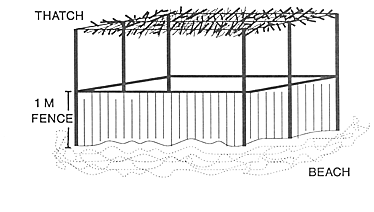
Hatchery design is simple (a fence or wall with a roof over it; Figure 1), but materials and dimensions vary. Since the degree to which a hatchery is shaded varies with hatchery construction, hatchery design can affect incubation temperature. Incubation temperature, in turn, contributes significantly to the determination of sex in sea turtle embryos (Yntema and Mrosovsky, 1980; Morreale et al., 1982; Rimblot et al., 1985). The objective of our study was to determine if female hatchlings were produced in each of the different types of hatcheries.
Figure 1. Hatchery design: Coconut palm leaves are laid over cross-poles or wire and tied with string. Leaves are spaced to allow sunlight and rain to filter through; they can be adjusted to modify temperature and humidity. Metal sheeting or thick palm thatch can also been used for roofing. Fences are constructed of boards, wooden poles, palm veins or sheeting of plastic, metal or "Duralita". The fence base is buried to thwart excavating predators.
Background
The hatcheries in this study were located along the Pacific coast of Guatemala at Monterrico, Candelaria, Hawai, and Las Lisas. The climate is generally very hot, even in the rainy season. Mean annual air temperature is 27.3°C (range 13.5-33.5°C) and mean annual rainfall is 1551.7 mm (Guatemala National Meteorological and Seismographic Institute, INSIVUMEH). The rain almost always falls at night and the days are usually sunny. The beach sand is medium to dark gray in color. Sand temperatures, measured by burying thermometers in the sand, were commonly as high as 39°C (and sometimes as high as 48°C) at depths of 35-45 cm (the depth of both natural and artificial L. olivacea nests).
It appears that these high sand temperatures result in low hatching success in both natural and artificial nests. We found that hatcheries with no shade (located ca. 24-100 m above the average high tideline) had 0% hatching success. Of 900 eggs transplanted and incubated in an unshaded hatchery at La Candelaria, not a single egg hatched. Similar results were obtained from unshaded trials in hatcheries at Las Lisas and Sipacate.
In in situ trials, L. olivacea eggs were transplanted to sites on the beach at the same location type and at the same depth as natural nests. None of these eggs hatched. Two natural L. olivacea nests which were protected from predators showed hatching rates of 42% (30/72 eggs) and 51% (40/78 eggs), respectively. [Shaded hatcheries normally yield 80-90% hatch success for L. olivacea; Table 1]. The sand temperatures at a depth of 35 cm ranged between 31-38°C during the incubation of the second nest. There were no identifiable embryos in the unhatched eggs of either nest; almost all unhatched eggs were at the top of the nest. We also observed that hatchlings crawling on unshaded sand died almost instantly.
Methods
The egg collection and incubation procedure for most hatcheries was as follows: each night, hatchery employees collected 12 eggs from each nest harvested by commercial harvesters. The eggs from one to several turtles of the same species were incubated together in a nest cavity excavated in moist hatchery sand, leaving about 25 cm of sand on top of the incubating eggs.
To determine the number of female hatchlings produced, hatchlings and late stage L. olivacea and D. coriacea embryos that died by accident or that failed to hatch were salvaged freshly dead from different hatcheries between 1985-1987. They were preserved in 10% buffered formalin and their gonads were analyzed histologically to determine sex. Instructions for the analysis of the gonads was provided by Dr. Larry P. Jones of the Texas Veterinary Medical Diagnostic Laboratory System.
Results and Discussion
Female hatchlings were produced in all hatcheries included in this study (Tables 1 & 2). Sample sizes are not large enough to accurately predict sex ratio, but a rough estimate is established for percent females. Temperature monitoring techniques were not consistent in the different hatcheries and therefore we do not include temperature data. Nonetheless, it was easy to observe with just the senses that certain designs of hatcheries were generally warmer than others. The warmer hatcheries tended to produce more females. The hatcheries with the highest production of female turtles had a low fence (opposed to high walls), a low roof of metal sheeting or palm leaf lattice, and no shade from other sources. Hatcheries with a low metal roof were fairly warm; the metal roof conducted heat which could be felt even at ground level. A high metal roof was warmer than a thick palm thatch, but the warmth was diminished more at ground level than was the case with the low metal roof. Hatcheries with thick palm-thatched roofs did not allow sunlight to enter and were very cool. All hatcheries with additional sources of shade from trees, buildings, etc. were cooler than those which had their roofs and walls exposed.
Table 1. Hatchery construction and the percent female L. olivacea hatchlings. "Eggs" refers to the total number of eggs incubated in the hatchery, estimated to the nearest 100; "% Hatch" was estimated by dividing the total number of hatched eggs into the total number eggs incubated in the hatchery; "N" refers to the total number of hatchlings sampled (eggs taken from an unknown number of nests); "M" (male), "F" (female).
|
Hatchery |
Year |
Construction |
Eggs |
% Hatch |
N |
M |
F |
%F |
|
Monterrico |
1985 |
Fence of "Duralita" 1 m high, palm leaf lattice roof, additional shade by trees to the east and building to the west. |
4000 |
80 |
18 |
13 |
5 |
27.8 |
|
Monterrico |
1986 |
Fence of "Duralita" 1-2 m high, palm leaf lattice roof, no additional shade. |
900 |
89 |
21 |
5 |
16 |
76.2 |
|
Monterrico |
1986 |
Fence of metal sheeting 1 m high, metal sheeting roof 2-3 m high, afternoon shade from building to the west. |
200 |
501 |
9 |
8 |
1 |
11.1 |
|
Candelaria |
1986-1987 |
Fence of plastic corrugated sheeting 80 cm high, metal sheeting roof 1.5-2 m high, no additional shade. |
3000 |
89 |
4 |
1 |
3 |
75.0 |
|
Candelaria |
1986 |
Fence of plastic corrugated sheeting 80 cm high, palm leaf lattice roof. |
500 |
802 |
8 |
3 |
5 |
62.5 |
|
Hawai |
1986 |
Walls of close-spaced poles 2 m high, thick palm thatch roof. |
4000 |
80 2 |
63 |
44 |
19 |
30.2 |
|
Las Lisas |
1986 |
Walls of close-spaced poles 2 m high, metal sheeting roof 2-3 m high, additional shade from building to the west. |
8000 |
80-902 |
5 |
4 |
1 |
20.0 |
|
TOTALS |
|
128 |
78 |
50 |
39.1 |
1
disturbed by children
2estimated to the nearest 10%
Table 2. Hatchery construction and the percent female D. coriacea hatchlings. "Eggs" refers to the total number of eggs incubated in the hatchery, estimated to the nearest 100; "% Hatch" was estimated by dividing the total number of hatched eggs into the total number eggs incubated in the hatchery; "N" refers to the total number of hatchlings sampled (eggs taken from an unknown number of nests); "M" (male), "F" (female).
|
Hatchery |
Year |
Construction |
Eggs |
% Hatch |
N |
M |
F |
%F |
|
Candelaria |
1986-1987 |
Fence of plastic corrugated sheeting 80 cm high, metal sheeting roof 1.5-2 m high, no additional shade. |
600 |
540 |
8 |
3 |
5 |
62.5 |
Hatcheries with palm leaf lattice roofs allow sunlight to filter through, are relatively warm, and have several advantages:
- temperature is adjustable by adding or taking away palm leaves,
- rain passes through the lattice, maintaining sand humidity (hatcheries roofed with metal sheeting or thick palm thatch require more frequent irrigation),
- leaves of coconut trees are obtainable at no cost,
- construction is easy, leaves are placed over a simple framework of poles, cord, or wire and are secured with string.
Hatcheries with low (vs. high) fences tend to be warmer because the fence itself casts little shade. The fences of 80-100 cm were adequate to exclude predators, especially since the hatcheries were guarded.
In summary, a simple, inexpensive and low maintenance hatchery roofed with palm leaf lattice and suitably fenced to exclude dogs, pigs, crabs, small children and other potential predators yielded high hatch success for L. olivacea and D. coriaceaeggs and produced both male and female hatchlings.
Morreale, S. J., G. J. Ruiz, and J. R. Spotila. 1982. Temperature-dependent sex determination: current practices threaten conservation of sea turtles. Science 216:1245-1247.
Ramboux, A. 1982. Programa de protección de las tortugas marinas en la costa sur-oriental del Pac'fico: resultados de la temporada de 1981. GUA/81/004. Acuicultura Experimental, Documento de Campo No. 1. DITEPESCA/FAO. Guatemala. 42pp.
Rimblot, F., J. Fretey, N. Mrosovsky, J. Lescure, and C. Pieau. 1985.Sexual differentiation as a function of the incubation temperature of eggs in the sea turtle Dermochelys coriacea (Vandelli, 1761). Amphibia-Reptilia 6:83-92.
Rosales Loessener, F. 1985. Informe sobre la situación actual de las tortugas marinas de las costa del Pacífico de Guatemala. DITEPESCA. Guatemala. 9pp.
Rosales Loessener, F. and A. Ramboux. 1982. Programa de protección de las tortugas marinas de la costa sur-oriental de Pacífico: resultados del cultivo "head starting" y resultados parciales de la temporada de 1982. GUA/81/004. Documento de Campo No. 8. DITEPESCA/FAO. Guatemala. 42pp.
Yntema, C. L. and N. Mrosovsky. 1980. Sexual differentiation in hatchling loggerheads (Caretta caretta) incubated at different controlled temperatures. Herpetologica 36(1):33-36.