Marine Turtle Newsletter 48:14-19, © 1990

Exploitation of Marine Turtles in Sri Lanka: Historic Background and the Present Status
Suhashini Hewavisenthi
Department of Zoology, The Open University of Sri Lanka, Nawala, Sri Lanka
seaturtle.org : MTN : ARCHIVES : Sign In
Marine Turtle Newsletter 48:14-19, © 1990
Suhashini Hewavisenthi
Department of Zoology, The Open University of Sri Lanka, Nawala, Sri Lanka
Five species of marine turtles, the green turtle (Chelonia mydas), the hawksbill (Eretmochelys imbricata), the olive ridley (Lepidochelys olivacea) the loggerhead (Caretta caretta) and the leatherback (Dermochelys coriacea) nest (currently and historically) in Sri Lanka. Most of the early accounts of marine turtles in Sri Lanka (formerly Ceylon) record their capture, slaughter, the method by which the scutes of the hawksbill turtle were removed, and the 'tortoiseshell' industry.
Around 1843 hawksbill turtles nested so freely along the southeastern coasts of the island, especially at Amaduwa, that the government sold the right to capture the animals to private individuals. Once captured, they were suspended over a fire and the heated scutes were removed. These turtles were then released on account of a mistaken impression that the scutes would regenerate and the animal could be caught again. In addition, there was a belief that if the scutes were stripped from a dead turtle, they would loose much of their translucent lustre. The scutes were used to make combs, cigar cases, fine boxes and other ornaments known as "tortoiseshell articles" and were exported both in a raw and manufactured state (Bennet, 1843). Flesh and eggs of turtles were used as food at Amaduwa. The only method used to capture turtles was to turn the nesting females on their backs.
In contrast, in Jaffna (see map) turtles were routinely captured with the use of harpoons and nets, in addition to turning the nesting turtles on their backs (Twynam, 1889). Three types of nets were used:
Outside the areas around Jaffna and the northwestern coast, turtles were caught only incidentally to other fishing enterprises. Most of these animals were released as they had no commercial value and the fishermen themselves did not consume turtle flesh (Anon., 1973).
Turtles were sold according to their size with prices ranging from 50 cents to 15 rupees including the shell [because of the severe depreciation against the US$ in recent years, no attempt has been made to convert rupees to US$; for reference, the present exchange rate is about Rs.40 per 1 US$]. Some 2,400-3,000 green turtles were killed annually between Kudremalai and Jaffna. Green turtle flesh was cured and preserved and the fat was used for oil in the Mannar district of the Northern Province (Twynam, 1889). The method by which pieces of green turtle flesh were sold (while the animal remained alive) is described by Tennent (1859). This practice attracted the attention of the Humane Society in England which induced the home government to compel authorities in Sri Lanka to pass a law against cruelty to animals (Ferguson, 1877) (Ord. No. 7, 1862). By 1900 local police were on the alert to prevent the butchering of live turtles and the barbarous method by which the scutes were removed (Cumming, 1901). However, the local demand for the tortoiseshell items was so great that exports were soon halted and raw scutes were imported from Penang (Malaysia) and the Maldive Islands (Suckling, 1876).
During the early 1960's the turtle fishery continued to be an important industry in Jaffna, the Gulf of Mannar, and in other parts of the northwestern coast. There was even a plan to freeze turtles and ship them to certain European markets (Somanader, 1963). Sometimes more than 100 turtles were caught in 4-5 days. The estimated catch in the Gulf of Mannar and Palk Bay was 3,000-4,000 and 1,000 per year, respectively (Jones and Fernando, 1968). The turtles were brought ashore and kept in pens. On Sundays they were turned on their backs at the market places and killed. While there are no records of the mass slaughter which must have been taken place, Parson (1962) reports that in Jaffna 20-30 green turtles were slaughtered each Sunday.
The flesh of the turtle was greatly relished in Jaffna, and as a consequence of superstitious beliefs that the blood gave invigorating powers, the blood was consumed as well (Anon., 1973). Turtles were also imported to Sri Lanka from India. When imports were restricted in the early 1970's (following a government policy of restricting imports in general during this time) and the demand for turtle flesh in the Northern Province could not be satisfied from local sources, certain traders induced the fishermen of the south and east coasts to retain turtles (all four species, except the hawksbill) accidentally caught in their nets and to deliver them to collecting centres. They were then transported to Jaffna in lorries (Anon., 1973).
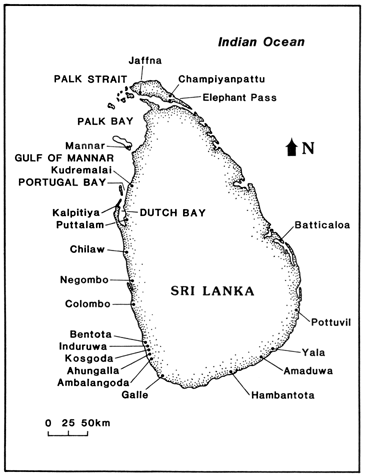
The need for legislation protecting sea turtles was increasingly clear, and often stressed by concerned individuals and organizations. As a result, all five species of turtle (and their eggs) on land or in the sea, were completely protected by an amendment to the Fauna and Flora Protection Ordinance in June 1972. Nonetheless, complaints on behalf of the fishermen, whose occupation was turtle fishing, resulted in a temporary lifting of the ban for a period of two years. However, even after the legislation was reactivated, turtle flesh and eggs continued to be sold in public markets, not only in remote areas but in the city and suburbs of Colombo (Anon., 1975). In the mid-1970's an estimated figure of 50,000 people depended on the turtle fishery for subsistence in Jaffna (Salm, 1975). About 1,500 turtles were taken annually in Jaffna and a total of some 3,000-5,000 animals were caught around the island (Hoffman, 1977 in Frazier, 1980). In addition, eggs were exploited throughout the island, especially from Colombo to Hambantota (Anon., 1973) and it has been estimated that some 20,000 eggs were consumed annually (Hoffman, 1975 in Wickramasinghe, 1981).
In May 1979 the Sri Lankan government joined the Convention on International Trade in Endangered Species (CITES), which prohibits international commerce (import/ export) of species listed in CITES Appendix I, which includes the five species of sea turtle inhabiting Sri Lankan waters. But local exploitation continued unabated. Advances in fishing technology put the turtles at a strong disadvantage. Traditional fishing crafts and nets were replaced by motor boats and strong nylon nets. From Ambalangoda to Kalpitiya, turtles were mostly caught incidental to other fishing activities (Jinadasa, 1984). They were entangled in large nets set to catch sharks, rays, squid and other large prey. As many as 16 turtles, mostly green turtles, were reported caught in a single large net (Dattatri and Samarajeewa, 1982). The catch observed in Negombo and Chilaw consisted mainly of olive ridley. Along the stretch of shore from Ambalangoda to Kalpitiya (roughly one-third of Sri Lanka's coastline), the number of turtles caught is about 4-5 per week during the heavy fishing season (November-March; non-monsoon) and perhaps one during the poor fishing season (monsoon period). Based on this information, a catch of 400 turtles per year for the entire island has been estimated (Jinadasa, 1984).
In the early 1980's, incidentally-captured turtles were not as likely to be released as in the past. However, for fear of the law, they were not unloaded at the fish landing sites, but instead were sold directly from the boats to reliable buyers (Jinadasa, 1984). The flesh of all five species of turtles was consumed and the price was around Rs.5/- pound. Today the situation is different. Despite the fact that people are generally aware of the laws protecting turtles, they are routinely caught and unloaded at fish landing sites where they are turned on their backs. Sometimes when the owner cannot find a buyer, the turtles stay in this manner in the hot sun for 3-4 days before slaughter. Even the endangered leatherback turtles suffer the same fate at Negombo and Kandakulliya (off Kalpitiya).
In the early 1980's turtle eggs were collected and consumed in many of the southwestern and southern coastal areas, but only a small percentage of people were involved in this activity. The price of eggs ranged from 25-50 cents for those of the small species, while those of the larger leatherback fetched up to one rupee each (Dattatri and Samarajeewa, 1982). In a few places, nesting females were also slaughtered. Exploitation of turtle eggs has increased tremendously along these beaches during the past few years. During the southwest monsoons (May to September) fishermen from the south traditionally have gone to the eastern coast to fish. Since ethnic problems flared in 1983, the Sinhala fishermen from the south have been unable to fish in the Tamil-dominated east and northeast areas. As a result, most of these fishermen indulge in collecting turtle eggs as a means of livelihood. Killing of nesting females has also increased along these beaches; today not a single nesting female is spared along the western coast. Current information on exploitation of turtles and their eggs along the northern and northwestern coasts are not available.
It is difficult to know the present extent of commerce in tortoiseshell (which continues despite CITES) because Sri Lankan customs statistics for export of worked tortoiseshell articles are categorized together with articles of ivory, mother-of-pearl, etc. Up to 1980, statistics for unworked tortoiseshell were categorized together with horns, beaks, hooves, etc. According to post-1980 statistics, there have been imports of raw tortoiseshell only during the last two years: 1987: Malaysia (88 kg) and Maldives (69 kg), 1988: Maldives (263 kg). Government shops as well as private shops in Colombo (and other major cities) display tortoiseshell articles for sale. This is primarily a tourist-oriented activity, as the items are very expensive and few residents can afford to buy them.
The coast of the Yala National Park in the southeastern coast of Sri Lanka has proved to be a major nesting ground for the leatherback turtle. Yet Jayawardana and Pereira (1988) reported a significant reduction of the number of nesting leatherbacks in 1988, compared to those during the period 1982-1984. Eighteen nesting turtles (four species) in a single night were recorded on the 5 km beach from Induruwa to Ahungalla along the southwestern coast (Dattatri and Samarajeewa, 1982). But now, except for very few green turtles and olive ridleys, there is very little nesting along this stretch. This fact is emphasized by the reduced number of egg clutches reaching the [Kosgoda] Victor Hasselblad turtle hatchery situated in this area. The number of egg clutches have reduced during 1986-1988 from 174 to 61 (olive ridley), 43 to 10 (leatherback), 33 to 3 (hawksbill), and 45 to 0 (loggerhead). In contrast, the number of green turtle clutches have increased from 303 to 349 during this period (unpubl. data, Victor Hasselblad hatchery at Kosgoda).
There are no special reserves for turtles in Sri Lanka, but Wilpattu and Yala National Parks include about 30 and 40 miles of coastline in the northwest and southeast, respectively. The laws protecting turtles are simply not effective because they are not properly enforced. Despite warnings by far-sighted individuals and organizations on the effect of over-exploitation of turtles and their eggs, this activity continues all over the island, throughout the year virtually unchecked.
Anonymous. 1973. The turtles and us. Loris 8(1):8.
Anonymous. 1975. Back to turtles. Loris 8(5):236.
Bennet, J. W. 1843. Ceylon and it's capabilities. Reprint Rajagiriya (Sri Lanka). Trumpet Publishers Ltd. (1984) Chapter 34:273-276.
Cumming, C. F. G. 1901. Two happy years in Ceylon. London, Chatto and Windus, pp.53-54.
Dattatri, S. and Samarajeewa, D. 1982. The present status and distribution of sea turtles in southwest and southern Sri Lanka - a preliminary survey report. 6p. Unpubl. report, March for Conservation, Colombo.
Ferguson, W. 1877. Marine Turtles, p.8-9. In: Reptile Fauna of Ceylon. Colombo, Willium Henry Herbert, Government Printer.
Frazier, J. 1980. Sri Lanka: exploitation of marine turtles in the Indian Ocean. Human Ecology 8(4):355-356.
Jayawardena, C. V. and Pereira, R. 1988. Sea turtle nesting in Yala National Park, block 1, for years 1981-1984 and 1988, p. 129. In: Proc. Sri Lanka Assoc. Advancement of Science, 44th Session.
Jinadasa, J. 1984. The effect of fishing on turtle populations. Loris 16(6):311-314.
Jones, S. and Fernando, A. B. 1968. The present status of the turtle fishery in the Gulf of Mannar and Palk Bay, p.712-715. In: Proc. Symp. Living Resources of the Seas Around India. Cochin, Central Marine Fisheries Research Institute.
Parson, J. J. 1962. The Green Turtle and Man. Univ. Florida Press, Gainesville. 54pp.
Salm, R. V. 1963. Jaffna's turtle trails. Loris 9(5):312-314.
Suckling, H. J. 1876. Chelonia, p.202-204. In: Ceylon, A general description of the island's historical, physical, statistical, containing the most recent information. By an Officer late of the Ceylon Rifles. Vol. 2, London, Chapman and Hall.
Tennent, J. E. 1859. Ceylon - An account of the island topographical with notices of it's natural history, antiquities and productions. 4th revised edition. Vol. 2. London, Longman and Roberts 1860:177-178.
Twynam, W. C. (Compiler) 1889. The Ceylon turtle. Ceylon Literary Register, 3(51):406-408, 3(52):415-416.
Wickramasinghe, S. 1981. Turtles and their conservation. Loris 15(6):313-315.