seaturtle.org :
MTN :
ARCHIVES :
Sign In
Marine Turtle Newsletter 48:21-22, © 1990

Sea Turtles in Turkey
Prof. Dr. Ibrahim Baran
Dokuz Eylül Üniversitesi, Buca Egitim Falültesi, Fen Bölmü Baskani, Buca - Izmir, Turkey
A study took place in 1988 with the purpose of evaluating sea turtle populations along the coasts of Turkey, which have not yet been polluted. The study was supported financially by the World Fund for the Development of the Natural Environment and was carried out with the help and guidance of German and Dutch scientists. All coasts potentially supporting sea turtles were examined. In this way, more specific knowledge could be obtained on the species which nest along the seasides of Turkey.
The coastline extending from Büyük Menderes to the border of Syria was divided into four areas, and studied by four groups. The study was carried out in two phases, nesting (June) and hatching (August and September). During the nesting season, the number of turtles depositing eggs in suitable areas were counted. During the hatching season, the condition of offspring leaving the nests was determined. Caretta caretta and Chelonia mydas were found to nest along the shores of Turkey in the following order (see Map for locations):
- At the extreme west, Caretta caretta nests on a sandy iztuzu which is near Dalyan village. On this 3.5 km sandy beach, a large tourist hotel had been planned and the foundation laid before construction was halted at the protest of environmentalists. Afterwards, the decision was made to preserve the ecosystem there in its natural state.
- The second area where turtles are found is the Dalaman coast. The main problem here is pollution of both coast and sea by a nearby paper factory.
- The Patara coast is one of the areas where sea turtles often nest. Some companies have started to construct tourist facilities in this area, which seems peaceful at the moment.
- At the Kizilot coast sea turtles are often reported. New tourist establishments and the construction of summer houses are proceeding rapidly; some buildings have been constructed without a building permit.
- There isn't much tourist development now along the coast surrounding Gazipasa. However, as a newly discovered area, tourist investment plans are being made.
- The construction of summer houses has begun at the Göksu delta which has been endangering the sandy coast and marshy area there. However, we have recently found out from the media that some measures have been taken to protect his area; notably, the area is going to be under the control of the Ministry of Agriculture and Forests.
- The Kazanli area in the Mediterranean has a great importance for Chelonia mydas, an endangered species. The importance (to the turtles) of this sandy area, which is not extremely wide or long, is the fact that the other sections of the coast are occupied by summer houses and factories. Therefore, nests are most often constructed in the Kazanli sands. The west side of the beach was closed by the soda factory and a field still remains on the north side. Seaward of the field a fence had been made with bushes, but when the worn-out fence was restored it was moved a bit closer to the sea so as to widen the field. As a result, the nesting beach was considerably narrowed. Nonetheless, it is still possible to see a typical sandy area of about 6-7 m behind the fence and some turtles build nests at the inner side by digging though the bottom of the fence.
Another problem is that the lights belonging to the high buildings of the soda factory confuse the hatchlings and direct them towards the land instead of the sea. They often perish as a result. The beach establishments at the north side of the beach and the new white limestone road at the east and west sides of the beach establishments are also responsible for disorienting hatchlings. We have already discovered several offspring dead along the road and inside the field. The lights of nearby houses, beaches and factories in this area should be turned off during appropriate periods and the limestone road must be converted into asphalt. Procedures have been initiated to solve these matters.
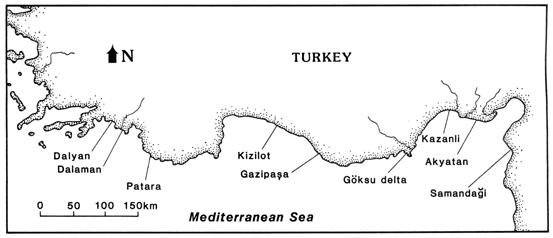
- The Akyatan area has been planted with trees by the Forest Administration to halt the sand dunes. The beach where turtles are often found is now protected. Necessary procedures have also taken place for there not to be a tourist establishment here, and positive results have been obtained.
- The Samandagi coast is not very active in tourism, but the beach has been destroyed in most cases because sand along the coast is taken for construction purposes.
Our studies are continuing on the protection of the sea turtles which nest on the coast of Turkey. In addition, a report on our research project is being prepared and should be published very soon.