seaturtle.org :
MTN :
ARCHIVES :
Sign In
Marine Turtle Newsletter 48:8-9, © 1990

First Recorded Nesting by Kemp's Ridley in Florida, USA
Anne Meylan1, Patricia Castaneda1, Colleen Coogan1, Tony Lozon2 and John Fletemeyer3
1Florida Marine Research Institute, 100 8th Avenue, S.E., St. Petersburg, Florida 33701
2Florida Environmental Preservation Association, 78 146th Avenue,
Madeira, Florida 33708
3Town of Palm Beach, P.O. Box 2029, Palm Beach, Florida 33480
Kemp's ridley (Lepidochelys kempi), the most endangered of the world's sea turtles, has a highly restricted nesting distribution. Approximately 95% of the nesting population emerges on a single beach 32 km in length at Rancho Nuevo in Tamaulipas, Mexico. Only a small number of nesting records exist for localities elsewhere in Mexico and in Texas; there is one unconfirmed report from Colombia (Ross et al., 1989). On 30 May 1989 at 0930 hrs EST, a Kemp's ridley nested on Florida's west coast at Madeira Beach (27°47'N, 82°48'W; Pinellas County, 146th Ave. & Gulf Blvd.). This represents the first documented nesting of L. kempi in Florida. Although this species is regularly recorded along Florida's west coast, most animals are immature, based on carapace length (Ogren, 1989) (Figure 1).
The ridley deposited 116 eggs, which is a normal complement for this species; daytime nesting is also typical. The nest was inundated by storm tides on 6 June and moved within a few hours to higher ground. Eighteen hatchlings emerged at dawn on 27 July and an additional six emerged on 28 July, after incubation periods of 58 and 59 days, respectively. Several hatchlings that died in the nest are being deposited in the American Museum of Natural History.
The nest site was on a highly developed stretch of coast, with high-rise condominiums and a seawall immediately adjacent. Dozens of tourists witnessed the turtle's emergence and nesting. A videotape of the nesting sequence is archived at the Florida Marine Research Institute.
An attempted nesting by a second Kemp's ridley was recorded that same month on the east coast of Florida. On 22 May 1989 (1150 hrs EST), a ridley emerged at Phipps Ocean Park in Palm Beach (26°39'N, 80°02'W; Palm Beach County, 4 km north of Lake Worth Bridge). The turtle excavated a nesting chamber but did not deposit eggs. A second sighting of what was presumed to be the same turtle was made by JF on 30 May; crawls observed in the same vicinity on 23 May and 31 May are also attributed to this animal. No eggs were deposited during any emergence, as far as is known. A photograph of this ridley taken by JF on 22 May 1989 is archived at the Florida Marine Research Institute. Neither ridley was tagged.
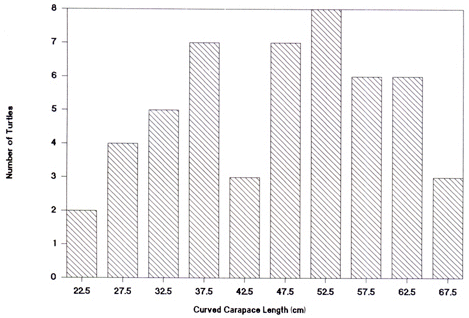
Figure 1
. Size distribution of Kemp's ridleys stranded along the Florida Gulf Coast, June 1981-September 1989. Minimum adult size is approximately 54 cm (René Marquez, personal communication). Source: Florida Department of Natural Resources Sea Turtle Stranding and Salvage Network [STSSN] data base.
Ogren, L. 1989. Distribution of juvenile and subadult Kemp's ridley sea turtles: preliminary results from 1984-1987 surveys, p.116-123. In: Proc. First Intl. Symp. on Kemp's Ridley Sea Turtle Biology, Conservation and Management (C. Caillouet and A. Landry, eds.). Texas A&M Univ. Seagrant Program (TAMU-SG-89-105).
Ross, J. P., Beavers, S., Mundell, D. and Airth-Kindree, M. 1989. The Status of Kemp's Ridley. Report to the Center for Marine Conservation, Washington D.C. 51pp.
[A note describing these events (both nesting and non-nesting emergences) has been submitted to Herpetological Review, Society for the Study of Amphibians and Reptiles.]