seaturtle.org :
MTN :
ARCHIVES :
Sign In
Marine Turtle Newsletter 60:8-14, © 1993

Western Australian Marine Turtle Conservation Project: An Outline of Scope and an Invitation to Participate
Robert I. T. Prince
Western Australian Marine Turtle Project Western Australian Wildlife Research Centre P. O. Box 51, Wanneroo, Western Australia 6065
The Fauna: Six of the world's seven species of marine turtle frequent the western Australian region, but only four are confirmed as breeding here: the green turtle (Chelonia mydas), flatback (Natator depressus), hawksbill (Eretmochelys imbricata), and loggerhead (Caretta caretta). The leatherback (Dermochelys coriacea) and olive ridley (Lepidochelys olivacea) occur but are not known to nest. The green turtle is the most abundant sea turtle in the region, utilizing major breeding sites at various places ranging from North West Cape northwards to the Lacepede Islands in the west Kimberley (Figure 1). The flatback is probably the next most abundant breeding species, frequenting nesting beaches on the mainland and offshore islands, ranging from the east coast of Barrow Island in the Pilbara to Cape Domett in the east Kimberley. Known hawksbill breeding sites are centered on the Pilbara region islands (Dampier Archipelago to Monte Bello group); this species is not abundant. The main loggerhead breeding sites are found on the Muiron Islands off Exmouth Gulf, and at Dirk Hartog Island in Shark Bay. The loggerhead appears to be the least abundant of the marine turtles found in the western Australian region. Of the non-breeding species, the leatherback is a regular (but not abundant) non-breeding migrant and the olive ridley is poorly known. The latter appears to frequent the far northern coastal waters of Western Australia in small numbers.
The Project: Some preliminary work commenced in the Pilbara region in late 1985, following a previous beach-use monitoring program conducted within the turtle nesting season for islands of the Dampier Archipelago. The major rookery-focussed work for the integrated project now in place did not begin until the 1986-1987 nesting season. It has only been during the past 1991-1992 nesting season that we have been able to do any intensive work on nesting loggerhead turtles. The project aims to:
- Gain an adequate understanding of the distribution and abundance of the various marine turtle populations utilizing western Australian region breeding sites and marine habitats, the nature of inter-relationships within species at the regional level between the groups using the different breeding sites, and the linkages between breeding sites (rookeries) and living/feeding areas of importance for the maintenance of these adult turtle populations;
- Develop an understanding of the processes affecting maintenance and abundance of sea turtle populations as an aid to addressing real management needs, including a consideration of matters relevant to continuing exploitation of turtles for food by Australian Aboriginal people; and
- Develop appropriate management measures, and interpretation/extension material to assist in education of the public where needed.
The major part of the field program to date has resulted in tagging of nearly 10,000 mainly adult female turtles during the six nesting seasons from 1986-1987 through 1991-1992, inclusive. Nearly 9,000 of these have been green turtles (Table 1).
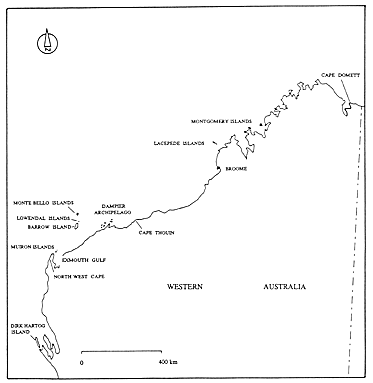
Figure 1. Study area: Western Australian marine turtle conservation project.
Tagging:All tags used for identifying individual adult and large juvenile turtles have been self-piercing, self-locking titanium tags equivalent in size to the National Band and Tag Co. monel tag #49, but of heavier gauge material (manufactured by Stockbrands Co. Pty. Ltd., Perth, Western Australia; see Limpus, 1992). These tags have been applied to all four species of nesting turtles on the trailing edge of the fore-flipper adjacent to the axilla, either on, or on the medial (inside) edge of the first large scale of the series found on this part of the flipper (equivalent to position 3; Limpus, 1992). Depending on circumstances considered relevant to each case, turtles are either single- or double-tagged on the first encounter. Most remigrant turtles have had additional tags applied to supplement whatever original tags have remained, thus increasing the chance of correctly determining individual identity on a continuing basis.
Table 1. Western Australian Marine Turtle Project, 1986-1992: Summary of Turtles Tagged by Species and Location. G = Green, F = Flatback, H = Hawksbill, L = Loggerhead; * Feeding ground captures only; + Confirmed nesting only (hatchlings seen emerging in two seasons).
|
Location |
G |
F |
H |
L |
Total |
|
Lacepede Islands |
3,960 |
29 |
+ |
-- |
3,989 |
|
Barrow Island |
2,249 |
70 |
-- |
-- |
2,319 |
|
Muiron Islands |
425 |
1 |
2 |
170 |
598 |
|
North West Cape |
1,475 |
-- |
25 |
57 |
1,557 |
|
Varanus Island
(Lowendals) |
40 |
50 |
245 |
1 |
336 |
|
Rosemary Island
(Dampier Archipelago) |
22 |
34 |
120 |
1 |
177 |
|
Cape Thouin
(Mundabullangana) |
-- |
286 |
-- |
-- |
286 |
|
Exmouth Gulf * |
329 |
-- |
4 |
20 |
353 |
|
Montgomery Islands * |
89 |
-- |
-- |
1 |
90 |
|
Other locations |
167 |
44 |
4 |
3 |
218 |
|
Totals |
8,756 |
514 |
400 |
253 |
9,923 |
The Work Program: Intensity of effort focussed on the different study areas has varied. The major nesting populations visiting the Lacepede Islands group have generally been sampled annually over a period of 12-15 days, initially in late November (1986) and more recently in early- to mid-December. There have been regular attempts to organize follow-up sampling in January-February, but only one such visit (February 1990) has been realized, due to adverse weather and transport difficulties intervening on other occasions. The Barrow Island nesting green turtles have generally been sampled at intervals spread throughout each nesting season since 1986-1987, although coverage has varied between seasons. The Varanus Island mixed species groups of nesting turtles have generally been monitored on a fortnightly on/off rotation for each season (1986-1987 through 1991-1992). North West Cape locations have received the most sustained coverage for the past four seasons (1988-1989 through 1991-1992), daily for about one month (December) in 1988-1989 and about two months (December-January) since.
Other locations have been worked at varying intensities. In part, this variation reflects the initial scarcity of knowledge required for the proper planning of field work in particular situations. It was possible to focus extended effort for the first time during the 1991-1992 season on loggerheads visiting the Muiron Islands, on hawksbills visiting Rosemary Island, and on flatbacks at Cape Thouin (Mundabullangana) because of progressive development over previous years of our species/site knowledge, and an increase in our ability to support additional work at these sites.
Nesting data: Curved carapace dimensions (length and width; Limpus, 1971) are routinely recorded, small sample counts of clutch size by the different species have been made at most rookeries, and, in some instances, we have been able to collect data on hatching and hatchling emergence. Some preliminary attempts have also been made in the field to monitor the nest environment and consequent sex determination of the young produced. To date, however, we have generally failed to obtain any substantial data on frequency of nesting by individual females within a nesting season, although we do have some observations showing that turtles can spend up to several months at a breeding site during a nesting season and lay up to four or five clutches (possibly more in some cases). This particular lack of data reflects the practical difficulties we have in maintaining an adequate extended monitoring effort on most of the study beaches.
Remigration and dispersal: As a result of the extensive work done over the past six years, we have a number of groups of nesting turtles with extended life history data; e.g., Lacepede Islands, 228 remigrant green turtles (observed intervals to date, 2-5 yr); Barrow Island, 17 green turtles (2-5 yr intervals); and combined North West Cape and Muiron Islands rookeries, four green turtles at 4-5 yr intervals and one at 2 yr. Most flatback data come from the Varanus Island and Cape Thouin groups; the 32 individuals seen include 15 with a 1 yr interval on first remigration, 10 at 2 yr, two at 3-4 yr, and one at 5 yr. Multiple remigrations have been observed for three green turtles. The 11 remigrant hawksbills seen at Varanus Island include one 2 yr, five 3-yr, three 4-yr, and two 5-yr intervals. The small number of loggerheads tagged prior to the 1991-1992 nesting season provide four remigrant observations: three at 2 yr and one at 3 yr intervals. Differences in the numbers of turtles recorded within the categories mentioned above generally reflect differences in the numbers of turtles actually tagged and work patterns achieved.
Preliminary dispersal data for turtles visiting some of our field study sites have been obtained (Figure 2), but coverage is uneven when considered across species and rookeries, plus one feeding ground location. All except one of the dispersal reports received have been for female green turtles (41 ex-Lacepede Islands with full data, four ex-Barrow Island, and five for the North West Cape and Muiron Islands) -- the exception being a female loggerhead ex-Muiron Islands. We do not have dispersal reports for any of our tagged hawksbill or flatback turtles. The uneven reportage of turtles away from their nesting grounds is believed to reflect a combination of very patchy distribution of human population and maritime activities that could lead to capture of tagged turtles in general, habitat preferences of the particular species of turtles relative to the types of maritime activities that are pursued in the region, and some probably quite variable incidence of failure to report captures of our tagged turtles in particular circumstances (e.g., illegal fisheries).
Our dispersal data have all been received as a result of hunting of turtles for human consumption. For the northern and northwestern Australian coastal locations ranging from Broome, Western Australia, to Mornington Island, Queensland (southeast Gulf of Carpentaria), reports (mostly green turtles) have come from people in coastal and island Aboriginal communities legally hunting turtles for food. One green turtle was reported taken in the Aru Islands (Indonesia) commercial net fishery during 1991. Other tagged turtles are known to have been taken, but insufficient data has been provided. The northern Australian region focus for these green turtle dispersal reports is further emphasized by the fact that 84% of the reports received have been for turtles using the Lacepede Islands rookery. Complementary to data from the recapture of tagged turtles, and in order to understand the structure of the breeding groups within species at the broad regional level, population genetic analysis based on mitochondrial DNA (mt DNA) profiles has been incorporated into our work. This collaborative project segment is led by Dr. Craig Moritz at University of Queensland. Species included to date are the green, hawksbill, flatback, and loggerhead.
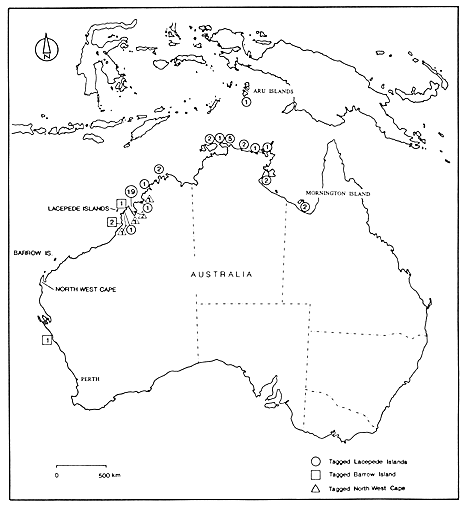
Figure 2. Dispersal of tagged green turtles from some Western Australian rookeries.
Off-rookery work: In addition to work in progress focussed on selected rookeries, there is ongoing development of an observer/reporter network aimed at improving our knowledge of the breeding turtles and breeding locations in our region, and in gaining further knowledge of species such as the leatherback, which occurs as a non-breeding, feeding migrant in Western Australian coastal waters. We also operate a small scale salvage program, based in Perth, covering mainly the southern west coast of the state of Western Australia, that aims to document the species and number of turtles involved, causes of death, and other pertinent biological/ecological data. Leatherback and loggerhead turtles are the predominant species found in these more temperate waters, but some greens are also encountered.
Juvenile growth studies at the feeding grounds are presently underdeveloped, but we do have one site where tagging and monitoring of a mixed species and age class assemblage of turtles has been in progress since late 1989. This work is primarily undertaken by a professional fisherman in parallel with his fishing operation based in Exmouth Gulf. A feeding ground population frequenting the Montgomery Islands reef in north western Western Australia was also sampled in August 1991. One of the adult green turtles in this group visited the Muiron Islands/North West Cape breeding area during the 1991-1992 season. It is considered desirable to expand this part of our work, and to extend it to involve at least one Australian Aboriginal community located on the Northern Territory north coast. Achievement of these objectives will require a considerable boost in available resources, apart from the necessity of maintaining support for the established work program in the near future. It is not easy to see where such support to maintain our core project work on a continuing basis, and to permit desirable expansion in the near future, can be secured.
Where do we go from here? MTN readers aware of the gaps in knowledge of marine turtle populations in the western Australian region (highlighted by Limpus, 1982) will be able to appreciate, from the information outlined in this paper, just how far we have now proceeded in redressing this deficiency. It will also be appreciated that maintenance of a core project by a dedicated professional management team provides the basis for extensive public involvement. In turn, public involvement produces a considerable multiplier effect on the value of the work done relative to the specific resources officially committed, although there are always additional management problems (and possible constraints on the scope of work that can be attempted) generated when this course of action has to be followed.
More specific and focussed research work of short duration can now be attempted in association with the broad brush approach outlined above. Apart from the primary purpose of informing MTN readers of the substance of our marine turtle project and the progress that has been made over the past six years, the secondary purpose of this article is to seek expressions of interest from independent research workers with access to their own resources who might like to link up with our project and extend the cover of work in progress in ways that might not be practicable for us to consider. Presently, the scale of the work being attempted, the consequent demands for project management services, and the need to concentrate on broader issues of natural resource documentation and management are more than enough to handle. People interested in becoming involved in collaborative field projects as noted above should write to the author. Please include details of the work you would like to attempt, the resources you have to support involvement, and the preferred timing of your participation, if acceptable. The major breeding period for the most accessible rookeries extends from late October through February.
Acknowledgements: The project depends on a widespread cooperative effort and shared material support. It has been supported from inception by Science and Information (=Research) Division and Pilbara Region, DCALM, and by the Australian National Parks and Wildlife Service (ANPWS) through its States Cooperative Assistance Program. Paul Lane (Broome Office, formerly Commonwealth Dept. Employment and Industrial Relations) secured funds to permit initial particiation of Bardi Aboriginal people in the Lacepede Islands work, 1986. Their continued participation has since been supported by the ANPWS Contract Employment Program for Aboriginals in Natural and Cultural Resource Management. West Australian Petroleum Pty. Ltd. has facilitated the work at Barrow Island, and Hadson Energy (formerly Bond Oil) has encouraged the volunteer work at Varanus Island (Lowendal Islands NR). Many people have made important contributions to the field program; my colleagues Keith Morris and Andy Williams deserve special mention in this regard.
Limpus, C. J. 1971. The flatback turtle, Chelonia depressa Garman, in southeast Queensland, Australia. Herpetologica. 27:431-46.
Limpus, C. J. 1982. The status of Australian sea turtle populations, p.297-303. In Biology andConservation of Sea Turtles (K. A. Bjorndal, Editor). Smithsonian Institution Press, Washington D. C.
Limpus, C. J. 1992. Estimation of tag loss in marine turtle research. Wildlife Res. 19:457-469.