Marine Turtle Newsletter 68:7-8, © 1995

The Turtle Harness: Reducing Handling and Transportation Stress
Ian B. Nielsen
Aquarist - Marine Operations, Sea World Enterprises,
Gold Coast, P. O. Box 190, Queensland, Australia
seaturtle.org : MTN : ARCHIVES : Sign In
Marine Turtle Newsletter 68:7-8, © 1995
Ian B. Nielsen
Aquarist - Marine Operations, Sea World Enterprises,
Gold Coast, P. O. Box 190, Queensland, Australia
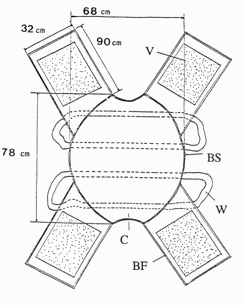
Physically handling medium to large marine turtles such as the loggerhead (Caretta caretta) or green turtle (Chelonia mydas) can pose several problems for both researcher and turtle. Damage or injury to the plastron and flippers may occur when large specimens need to be handled in awkward positions. The risk of lower back strain and lacerations to handlers is also a concern. During the course of our work, large numbers of turtles are restrained for analysis and data collection on board seagoing vessels. In need of a simple, effective handling device, we designed a turtle harness made of water- and abrasion-resistant materials (Figure 1). Materials include double layered, medium to heavy grade canvas; 25 mm wide polyester binding strips for hems; 50 mm wide seat belt webbing for handles and lifting straps; 15-20 mm thick polyurethane flexible foam in between double canvas layers of the harness base; hook-and-loop fastening material ("Velcro"), as wide as possible, stitched to either side of the four flipper binders with "hooks" on one side and "loops" on the other (each binding flap stitched identically); and heavy polycotton stitching thread.
|
Operation of the harness requires placing the turtle on the harness base with the animals' flippers positioned so they correspond with the four "Velcro" lined binding flaps. When restraining large turtles, one person kneels behind the turtle and reaches forward to pull back both fore flippers and place them under, and as close to, the carapace as possible. A second handler pulls both front binding flaps diagonally over the carapace. The "Velcro" immediately grips each binding flap together, thus restraining the turtle. Natural movements of the animal often push it forward, assisting in wedging the turtle tightly into the two front binding flaps. This procedure is repeated with the hind flippers, combining first the rear "Velcro" binding flaps and then all four binding flaps. This effectively both protects and restrains the turtle. The animal can then be lifted via the webbing handles, comfortably and safely. The curved, cut-out regions on the harness base align with the head and tail of the turtle, allowing full access without having to remove the harness. Individual flippers may be accessed for examination or surgical procedures by releasing the corresponding binding flap. |
Figure 1. Top view of the turtle harness (not drawn to scale). BF: binding flap, W: webbing lifting straps, BS: binding strips, C: double-layered, foam padded canvas, V: "Velcro". |
The harness has been successfully used in large turtle capture and tagging research trips conducted by the University of Queensland, Queensland Department of Environment and Heritage, and Sea World (Gold Coast, Australia). It has been invaluable during rescue and release exercises undertaken by Sea World when a lightweight, non-corrosive, durable, compact containment device is needed for use in small boats, aircraft, helicopters and the over-land vehicle luggage compartments. The harness has also been used for restraining active turtles out of water, for regular weighing and measuring, surgical and general husbandry procedures, and transportation within confined spaces. The harness is a very successful and effective method which we use regularly in all aspects of marine turtle care at Sea World.
The main benefits of the harness are
For the somewhat temperamental loggerhead turtles, the possibility of a "Velcro" attached hood, incorporating a combination of canvas and a gauze material to allow air circulation could easily be made. This would prevent damage to the cables, boat deck hoses, hydraulic lines, electrical wiring and helicopter seating as a result of relentless biting from annoyed loggerheads.
I would like to thank Sea World Marine Operations management and staff for allowing me to turn my ideas into reality and for providing practical situations in which to test the harness. Ron Bruce provided suggestions on material types and manufacture and Nancy FitzSimmons encouraged me to write an informative report, from which I hope other groups, most importantly marine turtles, can benefit.