seaturtle.org :
MTN :
ARCHIVES :
Sign In
Marine Turtle Newsletter 77:6-7, © 1997

RANGE EXTENSION: NESTING BY DERMOCHELYS AND
CARETTA IN SOUTHERN BRAZIL
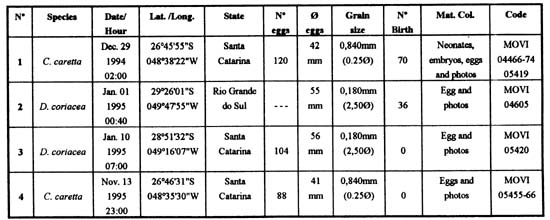
Nesting by sea turtles has been reported along the south Atlantic coast of Brazil as far south as the Biological Reserve of Comboios (19°45'S, 39°55'W), Espírito Santo (Marcovaldi and Albuquerque, 1982; Marcovaldi and Marcovaldi, 1987). This report describes the first evidence of nesting further south. Loggerhead turtles (Caretta caretta) and leatherback turtles (Dermochelys coriacea) are involved (Table 1). Collected material was deposited in the Museu Oceanográfico do Vale do Itajaí (MOVI).
Table 1. First records of sea turtle nesting in Brazil south of 26°S.
Complementary Data
1. Nesting occurred at Quilombo Beach, City of Penha. Onlookers witnessed the event, which lasted about two hours. Biometric data were not collected. Grain size analysis revealed a predominance of coarse sand. Hatching took place the night of 28 February 1995 after 62 days of incubation. A newborn (catalogued photos MOVI-05419), 46 x 35 mm straight-line carapace length x width, was kept in captivity and fed a carnivorous diet of Sardinella sp. (Clupeidae), Callinectes sp., Xiphopenaeus sp. (Decapoda) and Illex sp. (Cephalopoda). At the end of one month, its dimensions were 71 x 58.5 mm straight-line carapace length x width.
2. Nesting occurred at Paraíso Beach, City of Torres, and was reported by onlookers. Biometric data were not collected. Grain size analysis revealed a predominance of fine sand. The beach has a gradual slope, which led the animal to distance itself about 90 m from the sea, passing two small dunes and laying its eggs next to a pile of trash. Hatching took place on 5 March 1995 after 64 days of incubation. For two days post-hatching, the nest attracted the interest of two specimens of Didelphis albiventris (Mammalia, Marsupialia), but no plundering was observed. Four days after the primary emergence, more hatchling tracks were observed. However, since the nest could not be precisely located, it was impossible to prove that these hatchlings were from the same nest.
3. Nesting occurred at Plataforma Entremares, Rincao Beach, City of Içara. Onlookers witnessed the event (emergence from the sea, nest preparation, egg-laying, return to the sea), which lasted about three hours. Biometric data were not collected. Grain size analysis revealed a predominance of fine sand. After 60 days of incubation, the nest was exhumed. None of the 104 eggs showed any embryonic development.
4. Nesting occurred at Grande Beach, City of Penha. Grain size analysis revealed a predominance of coarse sand. The female was seen returning to the sea after egg-laying. Seven days later, the eggs were collected by beachgoers. The eggs were examined by museum specialists who confirmed that they had been developing until their intrusive removal from the nest. Eighty-eight eggs were counted; 50 (56.81%) had conjoined shells (Siamese, or "dumbbell shape").
We will add to this record a female (curved carapace length of 151 cm) found dead on 21 November 1991, a victim of a fishing incident. She was carrying dozens of developing eggs, whose shells had not yet calcified. Photographs were catalogued (MOVI-00574).
Acknowledgements: We are grateful for the assistance of Marco A. Baylon (CEPSUL / IBAMA) for information on the nesting at Quilombo Beach; Linoberto M. da Rosa for information on the nesting at Paraíso Beach; Joao L. Betiol for information on the nesting at Rincao Beach; Fernando C. Luz for information on the nesting at Grande Beach; and Armand H. Amin Jr. (LOG / UNIVALI) for grain size analyses.
Marcovaldi, G. G. D. and J. C. B. Albuquerque. 1982. Projeto Tartaruga Marinha. Bol. FBCN 17:70-74.
Marcovaldi, M. A. D. and G. G. D. Marcovaldi. 1987. Projeto Tartaruga Marinha. Areas de desova, épocas de reproduçao, técnicas de conservaçao. Bol. FBCN 22:95-104.
JULES M. R. SOTO, RODRIGO C. P. BEHEREGARAY and ROBERTO A. R. de P. REBELLO, Universidade do Vale do Itajaí - UNIVALI, Faculdade de Ciências do Mar - FACIMAR, Museu Oceanográfico do Vale do Itajaí - MOVI, Cx. P. 360 CEP 88302-202 Itajaí, SC, BRAZIL.