Marine Turtle Newsletter 78:2-7, © 1997

DISTANT FISHERIES IMPLICATED IN THE LOSS OF THE WORLD'S LARGEST LEATHERBACK NESTING POPULATION
seaturtle.org : MTN : ARCHIVES : Sign In
Marine Turtle Newsletter 78:2-7, © 1997
DISTANT FISHERIES IMPLICATED IN THE LOSS OF THE WORLD'S LARGEST LEATHERBACK NESTING POPULATION
Pritchard (1982) suggested that México was host to the largest nesting assemblage of endangered leatherback turtles (Dermochelys coriacea) in the world; estimated to number in the tens of thousands, the assemblage represented perhaps 50% or more of the global population. By 1996, when the first complete survey of leatherback nesting on the Pacific coast of México was finally undertaken, investigators were stunned to find that fewer than 1000 females had crawled ashore to lay their eggs during the 1995-1996 nesting season (Sarti et al., 1996). Sarti et al. (1996) reported an estimated annual rate of decline of 22.66% since 1984 when annual nesting data first became available for Mexiquillo beach, the largest nesting colony of leatherbacks in México (Figure 1). The comprehensive nature of the 1996 survey demonstrated that the decline was not due to emigration from Mexiquillo, but rather that a true population decline had occurred and that the data from Mexiquillo were likely to be indicative of a national trend.

Figure 1. Number of nesting crawls (nests and false crawls combined) made by leatherback turtles each year at Playa Mexiquillo, Michoacán, México (source: Sarti et al., 1996). Sarti et al. (1988) calculated an average annual frequency of 5.3 nests per female, leading to the conclusion that fewer than 1000 females nested in 1995-1996.
Preliminary results of an ongoing study may shed light on how such a steep decline developed over the course of a mere decade. In January 1997, nine leatherbacks were equipped with satellite transmitters while nesting at Mexiquillo beach, Michoacán, México. The transmitters (microprocessor-controlled Platform Transponder Terminals, PTT) were equipped with sensors to report dive depth and duration, time at depth, and time at temperature. The transmitters were attached to a flexible body harness (similar to that described in Eckert and Eckert, 1986) during nesting. With the exception that the Mexican units report temperature and are constructed for longer battery life, the same instrument design was used to successfully retrieve data for more than a year from leatherbacks departing nesting beaches in Trinidad (Caribbean Sea) in 1995 (Eckert, in press).
A complete description of this ongoing investigation will be prepared when the transmitters expire, but we feel that our preliminary results have immediate value to what is emerging as an international crisis. We are increasingly suspicious that the causes of this population collapse are to be found in waters hundreds and thousands of miles from México. The results of the first 10 months of tracking show that Mexican-nesting leatherbacks navigate to South American waters after egg-laying is complete (Figure 2).
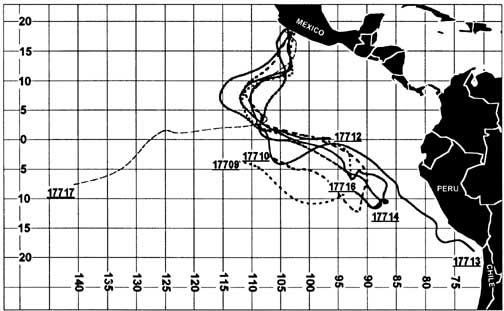
Figure 2. Post-nesting movements of seven leatherbacks from Mexiquillo, México; January-September, 1997.
Soon after deployment, one of the turtles was killed by a poacher, one unit ceased transmitting after nine days, and six turtles moved south immediately after their final nesting. One female, 17717, remained off the coast of México for about two months before travelling south; her behavior has continued to be anomalous when compared to her study mates (see Figure 2). Despite the diversion evident as they passed through the north equatorial current (at about 8o N), the turtles maintained their southwestern course toward the coasts of Peru and Chile. In late June and July, a warm water anomaly caused by a particularly strong (and ongoing) El Niño event may have been the impetus that redirected four of the turtles to the northwest; one stayed her course into Chilean waters (17712 ceased to transmit west of Galapagos). We believe that without this warm water anomaly, the turtles would not have turned north, but rather continued southwest to the South American coast with its rich upwellings and potentially abundant prey.
Our data compare nicely with a much shorter study by Morreale et al. (1996), who demonstrated that post-nesting leatherbacks leaving Costa Rica move south after nesting. The data further corroborate tag returns from leatherbacks killed in Chile after having been tagged during nesting in México and Costa Rica (Chandler, 1991; Marquez and Vellanueva, 1993). If the mounting evidence (suggesting that leatherbacks nesting on East Pacific beaches cross the equator to southern latitudes) is indicative of typical post-nesting migratory routing, then it is of critical importance to investigate the extent to which large commercial fishing fleets south of the equator may be contributing to regional population declines.
Chile supports the largest gillnet and longline swordfish fishery in South America. Since 1980, this fishery has grown exponentially with the gillnet fleet alone expanding from 4,777 days-at-sea in 1987 to 40,692 days-at-sea in 1993 (Figure 3) (Weidner and Serrano, 1997). The incidental killing of sea turtles by the gillnet fishery was first described by Frazier and Montero (1990), who provided data opportunistically gathered on 30 leatherbacks taken by vessels based at San Antonio, Chile. They estimated that 250 leatherbacks were taken annually by the San Antonio fleet. Following the publication of these data, local fisherman have refused to share information with Montero; however, based on information gathered from a variety of sources, he estimates the current annual take at approximately 500 leatherbacks (J. Montero, pers. comm., 1997). The estimate is not unreasonable given the nearly 10-fold increase in fishing effort since Frazier and Montero compiled incidental take reports in 1988-1990.
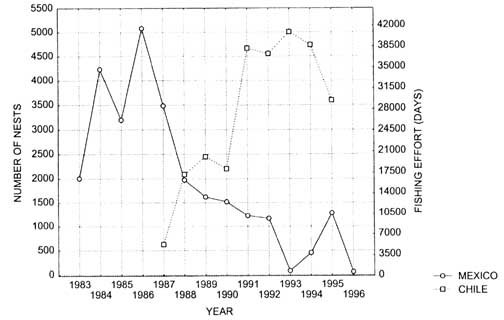
Figure 3. Decline in the number of leatherback turtle nests laid at Mexiquillo beach, México, and the gillnet fishing effort in Chile.
With the exception of San Antonio, there are no sea turtle incidental take statistics data available for Chilean fishing ports. Based on data from 1994 and 1995, San Antonio represents 28-32% of the Chilean gillnet fishing effort (Wiedner and Serrano, 1997). If leatherback capture rates are roughly equivalent among ports, the annual Chilean capture of leatherbacks could have been as high as 833 turtles in 1990 and more than twice that number today. Based on data reported by Frazier and Montero (1990), 80% of sea turtles captured in Chilean gillnets die. The situation is less clear in Peru. Brown and Brown (1992) described finding 167 leatherback carapaces in a canyon near the port of Pucusanain in October 1978; they concluded that at minimum of 200 leatherbacks were killed per year incidental to fishing operations based in that port alone. No other data are available.
Based on the information we have, it is not unrealistic to estimate that a minimum of 2,000 leatherbacks are killed annually by the combined swordfish fishing operations of Peru and Chile, and that this represents a major source of mortality for leatherbacks returning from protected nesting grounds in México and Costa Rica. It should be noted that these data account only for the gillnet fleets and do not include mortality associated with the growing longline fleets operated by Chile and other countries in these waters.
To place these fisheries-based estimates of mortality in context, it is useful to review other sources of known mortality. In México, there is a historical level of mortality associated with killing gravid females on their nesting beaches. In 1980, Pritchard (1982) conducted a two-day aerial survey of the Pacific coast from Maruata, Michoacán to the Isthmus of Tehuan-tepec, Oaxaca. The survey (31 October - 1 November) occurred during the first trimester of the nesting season. He counted approximately 155 beach carcasses (remains left behind by poachers). If we assume that the total number of carcasses was double or even triple Pritchard's observation, fewer than 500 turtles were lost that year and the annual tally has undoubtably declined since then. México has aggressively sought to prohibit the killing of leatherbacks on nesting beaches since the early 1980's. By the mid-1980's, field camps (staffed by biologists and often assisted by the Mexican military) protected nearly all of México's most important nesting grounds.
Incidental capture of leatherbacks by the North Pacific high seas driftnet fleet (targeting squid and tuna) was also a source of mortality during the 1980's and early 1990's. In 1990-1991, approximately 1000 leatherbacks were captured. Mortality is unknown, and can only be estimated at 10-100% (J. Wetherall, U. S. National Marine Fisheries Service, pers. comm., 1997). The range is based on observed levels of mortality (documented by on-board fisheries observers) and estimated levels of mortality after release. Most leatherbacks break free of the net during retrieval, but remain entangled in portions of the net. Wetherall et al. (1993) assumed that mortality following release is "high", and may reach 100% of entangled turtles. This fishery peaked during the years 1978-1990 (declining then until the fishery was terminated in 1993 by U.N. decree), meaning that the annual incidental take of leatherbacks was probably at least as high (i.e., ca. 1000 per year, as reported in 1990-1991) during the 1980's when fishing effort was at its peak and leatherback populations were still large.
These data, interpreted cautiously, indicate that mortality associated with the swordfish gillnet fisheries in Peru and Chile represents the single largest source of mortality for East Pacific leatherbacks, that this has been the case since the mid-1980's, and that this mortality has wholly negated the intense conservation effort put forth by México at the breeding grounds starting at roughly the same time. A comparison of annual nest production at Mexiquillo beach in México with driftnet fishing effort in Chile reveals a disturbing pattern (Figure 3). The pattern might be considered coincidental except that between 1990 and 1991, the driftnet fishing effort doubled from 18,150 days of fishing effort to 38,215 days of fishing effort. Assuming that this effort resulted in a proportional increase in mortality to leatherbacks, we would expect a substantial decrease in the number of turtles nesting in 1993 (the modal interseasonal nesting interval for leatherbacks is two years). Such a decline did occur. Further, in subsequent years, the fishing effort stayed elevated and the nesting population remained low.
With this analysis, we do not propose that all of the factors which have caused the drastic decline in the Mexican nesting population are accounted for. There is insufficient historical information on the killing of leatherbacks on the nesting beaches and their mortality in coastal and pelagic fishing operations (e.g, high seas longline fisheries which are known to catch leatherbacks; Balazs and Pooley, 1994). What is clear is that the decline of this population is severe and more rapid than has been documented for any other population or species of marine turtle. We propose that the speed at which this once huge population has declined indicates that large scale mortality of juvenile and adult turtles must have occurred. In contrast, the virtual extinction of the peninsular Malaysian leatherback nesting population, in which egg harvest was the primary culprit, took more than 50 years to accomplish (Leong and Siow, 1980).
In summary, we believe that the incidental killing of leatherbacks by swordfish fishing fleets plying the South American coast has played a major role in the collapse of the East Pacific leatherback population, a population which until recently was the largest in the world. We urge that immediate efforts be undertaken to reduce this take, and to assemble whatever additional data might be available to enable a more precise estimate of the incidental take over the last decade of this and other relevant fisheries. Further, research should continue with an aim to more fully understand the movement patterns and habitat needs of these highly migratory reptiles. It is only through behavioral studies that we can identify where leatherbacks are vulnerable throughout the Pacific. Finally, we strongly encourage that efforts be undertaken to reduce all forms of incidental mortality in non-target species caught in high seas fisheries. Without these efforts, the sustained recovery of depleted non-target species will never occur.
Balazs, G. H. and S. G. Pooley (Editors). 1994. Research plan to assess marine turtle hooking mortality: results of an expert workshop held in Honolulu, Hawaii, November 16-18, 1993. NOAA Tech. Memo. NMFS-SWFSC-201. U. S. Dept. Commerce.
Brown, C. H. and W. M. Brown. 1982. Status of sea turtles in the southeastern Pacific: Emphasis on Peru, p.235-240. In: K. A. Bjorndal (Editor), Biology and Conservation of Sea Turtles. Smithsonian Institution Press, Washington D.C.
Chandler, M. 1991. New records of marine turtles in Chile. Marine Turtle Newsletter 52:8-11.
Eckert, S. A. In press. Perspectives on the use of satellite telemetry and other electronic technologies for the study of marine turtles, with reference to the first year long tacking of leatherback sea turtles. In: S. P. Epperly and J. Braun (Compilers), Proceedings of the 17th Annual Symposium on Sea Turtle Biology and Conservation. NOAA Tech. Memo. NMFS-SEFSC. U. S. Dept. Commerce.
Eckert, S. A. and K. L. Eckert. 1986. Harnessing leatherbacks. Marine Turtle Newsletter 37:1-3.
Frazier, J. and J. L. B. Montero. 1990. Incidental capture of marine turtles by the swordfish fishery at San Antonio, Chile. Marine Turtle Newsletter 49:8-13.
Leong, Tak Seng and Kuan Tow Siow. 1980. Sea turtles in the east coast of Peninsular Malaysia and their economic importance, p.319-346. In: T. E. Chua and J. K. Charles (Editors), Coastal Resources of East Coast Peninsular Malaysia: An Asssessment in Relation to Potential Oil Spills. Univ. Sains Malaysia, Penang.
Marquez M., R. and A. O. Villanueva. 1993. First reports of leatherback turtles tagged in Mexico and recaptured in Chile. Marine Turtle Newsletter 61:9.
Morreale, S. J., E. A. Standora, J. R. Spotila and F. V. Paladino. 1996. Migration corridor for sea turtles. Nature 384:319-320.
Pritchard, P. C. H. 1982. Nesting of the leatherback turtle Dermochelys coriacea in Pacific Mexico, with a new estimate of the world population status. Copeia 4:741-747.
Sarti M., L., B. Jiménez, J. Carranza, A. Villaseñor and M. Robles. 1988. IV Informe Final de Trabajo. Investigación y Conservación de las Tortugas LaPoundd Dermochelys coriacea y Golfina Lepidochelys olivacea en Mexiquillo, Michoacán. Temporada de anidación 1987-1988. Sec. Desarrollo Urbano y Ecología Delegación Michoacán. 46 pp.
Sarti M., L., S. A. Eckert, N. Garcia T. and A. R. Barragan. 1996. Decline of the world's largest nesting assemblage of leatherback turtles. Marine Turtle Newsletter 74:2-5.
Weidner, D. and J. Serrano. 1997. "Latin America," World Swordfish Fishery. Vol. IV, Part 1B. NOAA National Marine Fisheries Service, Silver Spring, Maryland.
Wetherall, J. A., G. H. Balazs, R. A. Tokunaga and M. Y. Y. Yong. 1993. Bycatch of marine turtles in North Pacific high-seas driftnet fisheries and impacts on the stocks. Bulletin 53 (III) of the North Pacific Commission, p.519-538.
SCOTT A. ECKERT, Hubbs-Sea World Research Institute, 2595 Ingraham Street, San Diego, California 92109 USA and LAURA SARTI M., Lab. Tortugas Marinas, Facultad de Ciencias, UNAM Depto. Biología, Circuito Exterior, Ciudad Universitaria, México D.F. 04510 MEXICO and Instituto Nacional de la Pesca, Pitogoras 1320 5o Piso, Col. Sta. Cruz Atoyac, México D.F. 03200 MEXICO.