
RESULTS OF A 1996 SURVEY OF CHELONIA IN TURKEY
seaturtle.org : MTN : ARCHIVES : Sign In
RESULTS OF A 1996 SURVEY OF CHELONIA IN TURKEY
The majority of marine turtle nesting in the Mediterranean takes place in Greece, Turkey and Cyprus, with low density nesting reported in Libya, Egypt and North Africa. A large proportion of the Mediterranean Chelonia mydas [green sea turtle] population nests on the beaches of Turkey (Groombridge, 1988). Seventeen nesting beaches were identified during a 1988 field survey of the Turkish Mediterranean coast (Baran and Kasparek, 1989); three of them are important to C. mydas: Kazanli, Akyatan and Samandag. Negative developments associated with tourism are affecting the status of C. mydas populations in Turkey, as is the case in other Mediterranean countries. Other potential threats include human settlement, agriculture, industry, erosion, and pollution of coastal areas near nesting beaches (Table 1).
In 1996, a survey was conducted at Kazanli, Akyatan and Samandag beaches from 1 June - 1 September. Beaches were monitored nocturnally (2100-0600 hr). Track location, species and type of track were recorded; tracks were crossed to avoid duplicate counting. C. mydas nests were distinguished by the particular synchronous gait of the turtle (Ehrhart, 1982). Nests were located and labelled either as they were laid, or by using a probing stick the next morning (taking great care not to pierce any eggs). Nests were marked twice to minimise losses due to the removal of marks; one marking stake was planted near the nest (10 cm beneath the sand) and a second was planted 1 m behind the nest. Nests were excavated and the remains examined about one week after the first hatchlings emerged (cf. Whitmore and Dutton, 1985).
Table 1. Major threats to the sea turtle nesting beaches in Turkey.
| Beach | Major threats | Protected status |
| Kazanli | Soda-chrome factory, agriculture, settlement, local tourism, lights | None |
| Akyatan | Coastal erosion, marine fishing. pollution | Wildlife Reserve |
| Samandag | Coastal erosion, sand mining, pollution | None secondary houses |
In all, 128 C. mydas nests were found on Kazanli Beach. Nest density was estimated to be 32 nests/km. On Akyatan Beach, 179 C. mydas nests were counted; 35 C. mydas nests were counted on Samandag Beach (Table 2). It is difficult to compare these results with previous studies due to differences in methodology; in particular, due to differences in survey time. However, comparisons are possible with a 1994 survey conducted of Caretta caretta and C. mydas nests along the Turkish Mediterranean (Yerli and Demirayak, 1997) because the 1994 and 1996 studies were conducted at the same time of year. A decrease in the numbers of nests is evident, particularly at Akyatan (Figure 1). We have insufficient data to conclude whether the decrease is due to natural fluctuation or man-induced harm. Natural fluctuations in the annual number of nests laid can be as high as 50% (Davis and Whiting, 1977; Talbert et al., 1980).
Table 2. Selected data from a survey of C. mydas nests laid in Turkey in 1996.
| Beach | Total Crawls | Nests | % Nests | Beach Length | Nests/km |
| Kazanli | 65 | 31 | 28 | 194 | 32 |
| Akyatan | 43 | 91 | 79 | 402 | 09 |
| Samandag | 12 | 74 | 43 | 59 | 5 |
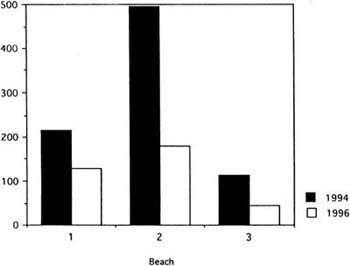
Figure 1. Comparisons between 1994 and 1996 survey results. 1 = Kazanli, 2 = Akyatan, 3 = Samandag.
The certain result of this survey is that these three beaches remain vital to the survival C. mydas in the Mediterranean Sea.
Baran, I. and M. Kasparek. 1989. Marine turtles of Turkey, status survey 1988 and recommendations for conservation and management. WWF, Verlag, Heidelberg. 123 pp.
Davis, G. E. and M. C. Whiting. 1977. Loggerhead sea turtle nesting in Everglades National Park, Florida, USA. Herpetologica 33(1):18-28.
Ehrhard, L. M. 1982. A review of sea turtle reproduction, p.29-38. In: K. A. Bjorndal (Editor), Biology and Conservation of Sea Turtles. Smithsonian Inst. Press, Washington D.C.
Groombridge, B. 1988. Marine turtles in the Mediterranean: Distribution, population status, conservation. IUCN World Conservation Monitoring Centre, Cambridge. 57 pp.
Talbert, O. R., S. E. Stancyk, J. M. Dean and J. M. Will. 1980. Nesting activity of the loggerhead turtle (Caretta caretta) in South Carolina I: A rookery in transition. Copeia 4: 709-718.
Whitmore C. P. and P. H. Dutton. 1985. Infertility, embryonic mortality and nest-site selection in leatherback and green sea turtles in Suriname. Biological Conservation 34:251-272.
Yerli, S. V. and F. Demirayak. 1997. Turkey's sea turtles. DHKD Coastal Management Section Report Series 96 (in press).
S. V. YERLI and A. F. CANBOLAT, Hacettepe University, Department of Biology, Aquatic Life Laboratory (SAL), 06532 Beytepe / Ankara, TURKEY.