seaturtle.org :
MTN :
ARCHIVES :
Sign In
Marine Turtle Newsletter 80:5-7, © 1998

Activities by Project TAMAR in Brazilian Sea Turtle Feeding Grounds
Maria Ângela Marcovaldi, Cecília Baptistotte,
Jaqueline C. De Castilhos, Berenice Maria G. Gallo,
Eduardo Henrique S.M. Lima, Taisi Maria Sanches &
Claudia F. Vieitas
Project TAMAR, CP 2219, Rio Vermelho, Salvador, BA,
Brazil, 40210-970.
(Fax: 55 71 876-1067; E-mail: protamar@e-net.com.br)
The main sea turtle nesting sites in Brazil have been protected since 1980 by TAMAR (Brazilian Sea Turtle Conservation Program), a federal government initiative of IBAMA (Brazilian Institute for the Environment), co-managed by Fundação Pró-TAMAR, a non-governmental organization. Since then, TAMAR has collected information on dead and stranded turtles found along the Brazilian coastline. After the establishment of research stations at the main nesting areas (Figure 1), TAMAR began, in 1991, to work in the main feeding grounds, where the level of incidental capture reported is high (Marcovaldi 1991). The first efforts to increase protection of sea turtles found in these areas were at Ubatuba, São Paulo State (Figure 1).
The marine turtle species found in Brazilian waters
are the loggerhead (Caretta caretta), green (Chelonia
mydas), leatherback (Dermochelys coriacea), hawksbill
(Eretmochelys imbricata) and olive ridley (Lepidochelys
olivacea) turtles (Marcovaldi & Marcovaldi 1985).
Detailed information on the fishing methods that most
often capture marine turtles in Brazilian coastal waters,
has been gathered, and are now being described and
compiled in a manual (Fundação Pró-TAMAR,
in prep.). Fishing methods are mostly artisanal, the
most common being: floating weirs, set nets and fish
traps. This census will help to identify the main threats
to the turtles in their feeding grounds and also aid
development of appropriate management and conservation
strategies necessary to address their impacts.
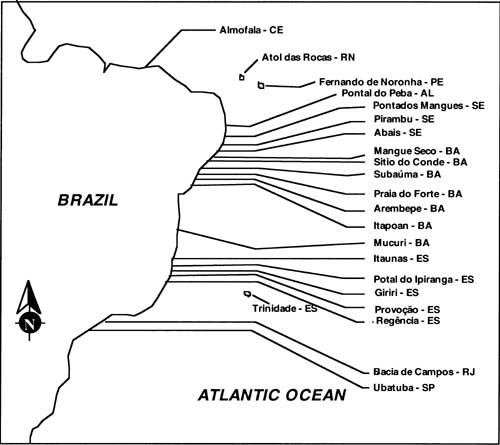
Figure 1. Research stations of the Brazilian Sea Turtle Conservation Program (TAMAR).
The work is divided into two major strategies: firstly,
environmental education is undertaken at sites of high
levels of incidental capture, mainly Ubatuba and Almofala;
secondly, at-sea research studies are carried out on
behaviour and growth parameters, at sites with good
diving conditions, mainly Fernando deNoronha and Atol
das Rocas (for more details, see Bellini & Sanches
1996). Through the campaign, "Not everything caught
by the fishing net is fish", techniques helpful
in minimizing mortality of incidentally captured turtles
are taught to the fishermen and the coastal communities
in general. Employing the people involved in fisheries
activities to work for the protection of turtles, checking
the nets for turtles, and creating new ecologically
sound economic alternatives are all parts of the program.
Following the methodology applied in the nesting areas,
a database has been created to organize and standardize
the collection of information in the feeding grounds.
Date, time of occurrence, condition of turtle (alive
or dead), curved carapace length and width, species,
sex (when possible), tag number and the final outcome
(dead, released at sea or held in recovery tanks) are
all recorded.
The number of turtles saved and released at sea have
increased annually at TAMAR stations (Figure 2). Of 2,000
turtles captured by fisheries participating in the
scheme since 1991, 1,848 (92.4%) were safely released,
mainly in the fishing communities of Ubatuba and Almofala.
At Ubatuba, most (99.3%) of the turtles captured were
juveniles, as well as in Almofala (70.1%), where the
greatest majority of individuals were Chelonia mydas
(97.7% in Ubatuba and 92.8% in Almofala). At Atol das
Rocas and Fernando de Noronha, 1,087 captures of sea
turtles were recorded as part of the underwater studies.
The species most frequently found were hawksbill (83.9%
at Fernando de Noronha and 59.2 % at Atol das Rocas)
and green turtles (15.5% at Fernando de Noronha and
40.8% at Atol das Rocas). All individuals at Atol das
Rocas were juveniles versus 81.7% at Fernando de Noronha,
where a proportion were adult green turtles.
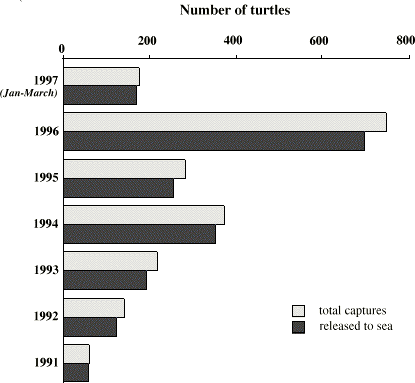
Figure 2. Number of turtles captured and in fisheries and released as part of work carried out at TAMAR stations.
Because individuals are tagged before release, upon
recapture, data can be obtained on growth rates and
behaviour. Through these research and conservation
activities, TAMAR is gaining a better understandingof
sea turtles at different life history stages and working
to protect them as well as their habitats. All work
is carried out with due consideration of the environmental,
social, economic and cultural conditions of the local
communities.
Acknowledgments: We thank Matthew Godfrey and Charles
Tambiah for help with the manuscript. TAMAR is supported
by Petrobras, affiliated with IBAMA, and co-managed
by Fundação Pró-TAMAR.
BELLINI, C. & T.M. SANCHES. 1996. Reproduction and
feeding of marine turtles in the Fernando de Noronha
Archipelago, Brazil. Marine Turtle Newsletter 74: 12-13.
BELLINI, C. & T.M. SANCHES. 1998. First record
of a loggerhead turtle in the Fernando de Noronha Archipelago,
Brazil. Marine Turtle Newsletter 79: 22.
FUNDAÇÃO PRÓ-TAMAR. in preparation.
Manual das artes de pesca que capturam tartarugas marinhas
no Brasil.
MARCOVALDI, M.Â. 1991. Sea Turtle Conservation
Program in Brazil expands activities. Marine Turtle
Newsletter 52: 2-3.
MARCOVALDI, M.Â. & G.G. DEI. MARCOVALDI. 1987.
Projeto Tartaruga Marinha: áreas de desova,
época de reprodução, técnicas
de preservação. Boletim Fundação
Brasileira para Conservação da Natureza
22:95-104.