seaturtle.org :
MTN :
ARCHIVES :
Sign In
Marine Turtle Newsletter 82:5-7, © 1998

Site Fidelity and Size Frequencies of Juvenile Green Turtles (Chelonia mydas) Utilizing Near Shore Reefs in St. Lucie County, Florida
Michael Bresette, Jonathan Gorham & Bruce Peery
Quantum Resources Inc. P.O. Box 30008 Palm Beach Gardens, FL 33410 USA (E-mail: Michael_Bresette@fpl.com)
The St. Lucie Nuclear Power Plant is located on Hutchinson Island in St. Lucie County, Florida, USA. It draws cooling water from the Atlantic Ocean, through three large diameter pipes (3.9 - 4.9 m), into a 1500 m long intake canal. The structures housing the intake pipes are 365 m offshore in about 7 m of water. The pipe openings are vertically oriented and are situated 3 m above the ocean floor. A large velocity cap sits approximately 2 m above each pipe opening and extends more than 3 m beyond the pipe diameter. Turtles encountering these structures are often transported into the intake canal where they are captured with tangle nets, dipnets and by SCUBA divers. Morphometric data is collected from each turtle, tags are applied to both front flippers and the turtle is returned to the ocean approximately 750 m north of the canal.
From March of 1976, when the power plant began operation, to April 1998, 5727 sea turtles were captured at the plant's intake canal. This total includes 3357 loggerhead (Caretta caretta), 2297 green (Chelonia mydas), 34 Kemp's ridley (Lepidochelys kempii), 20 leatherback (Dermochelys coriacea) and 19 hawksbill (Eretmochelys imbricata) turtle captures. The vast majority of turtles entering the canal are in good condition and are not affected adversely by their rapid entrainment. Although some mortalities have occurred (<3.3% overall; <1.2% since 1990), constant evaluation and modification of capture technique has minimized these incidents.
The benthic environment near the intake structures consists primarily of sand and shell sediments (ABI 1991), although just to the southwest (<450 m) of these structures lies an extensive worm-rock reef system created by a species of sabellariid polychaete. Colonies of these worms create reef structures that are parallel to the shore and are commonly found in 1-10 m of water. Worm-rock reefs in Florida stretch from Indian River County to Key Biscayne, and appear to be an important developmental habitat for immature green turtles (Guseman & Ehrhart 1990; Ehrhart 1992).
From July 1994 to April 1998, 1673 green turtles were captured at the power plant's intake canal; 210 juvenile green turtles accounted for 614 of these capture events. Many of these juvenile turtles were captured numerous times, with one individual being captured 13 times in a three year period. All recaptured juvenile green turtles were recaptured at the canal an average of two times after initial capture. The number of recaptures found at the intake canal might actually be much higher as many turtles have been observed with obvious tag scars. The use of PIT tags in the future may help to alleviate this ambiguity.
The increase in recapture rates from just over 5% in 1994 to a high of over 40% in 1997 (Figure 1.) indicates that the population of turtles utilizing the reef system near the intake structures may be approaching saturation with tags from the power plant. This high rate of recapture also suggests that many of these turtles are utilizing this reef habitat for extended periods of time and may not be moving far from the area. This is also evident in tag return data. Out of 17 tag returns of juvenile green turtles, five were found less than 10 km from the study site, 9 were found between 15 and 60 km away and only 3 were found 140 km away at the Trident submarine turning basin at Port Canaveral.
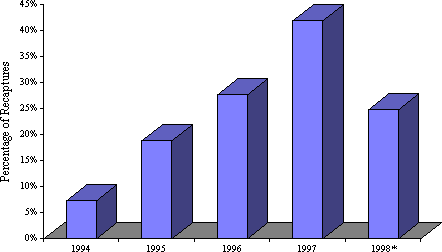
Figure 1. Percentage of total green turtle captures that were recaptures, 1994-1998 *Up to April 30th 1998.
The size frequency of green turtles captured at the intake canal shows a population of predominately juvenile turtles (Figure 2.). Straight carapace lengths (SCL) ranged from 20.8 - 105.3 cm with a mean of 39.6 cm. This population structure is not unlike populations of green turtles found in other study sites on the east coast of Florida. Green turtles on similar reefs approximately 100 km to the north of this site ranged in size from 25.1 - 67.0 cm SCL with a mean of 41.1 cm, while green turtles in the Indian River Lagoon system in Brevard and Indian River Counties ranged in size from 24.3 - 97.2 cm SCL with a mean of 40.8 cm (Ehrhart et al. 1996). Additionally, a group of juvenile green turtles was found to utilize a large expanse of hard bottom reef just offshore of Broward County (Wershoven & Wershoven 1990).
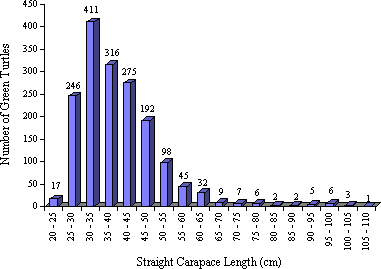
Figure 2. Size frequency of green turtles captured at the St. Lucie power plant intake canal, July 1994-April 1998, n=1673.
The size structure and residency times of turtles inhabiting the reef system adjacent to the intake structure indicates this area serves as a developmental habitat, similar to the areas mentioned above. These turtles appear to recruit to this near shore reef area when they reach approximately 25 - 30 cm SCL and seem to move on to other sub-adult habitats when they approach 65 cm SCL.
Historically, captures at the St. Lucie Power Plant have been dominated by loggerhead turtles. From 1976 through 1992 over 83% of all captures were loggerheads, while only 15% consisted of green turtles (ABI 1993). A dramatic increase in green turtle capture rates began in 1993 and green turtles now account for over 40% of all captures (Quantum Resources 1998). This capture rate is thought to be due to the increase in numbers of juvenile green turtles utilizing the offshore area surrounding the intake structures.
The intake structures are covered by much of the same flora as Ehrhart (1992) found growing on worm-rock reefs in Indian River County; a diverse assortment of green, brown and red algae. Juvenile green turtles have been observed foraging on these types of algae on the banks of the intake canal and on shallow worm-rock reefs just west of the intake structures. These observations are consistent with the algal diets of juvenile green turtles found on the shallow reefs of Broward and Indian River Counties (Wershoven & Wershoven 1989; Ehrhart et al. 1996 ). While foraging, these green turtles likely view the intake structures as an extension of the reef system and upon entering these structures are entrained with seawater into the canal system.
A high level of site fidelity to these near shore worm-rock reefs is evident and underscores the impact these reefs have on the development of juvenile green turtles. Future capture data from the power plant will enhance our understanding of the turtles utilizing the near shore reefs of St. Lucie County, Florida.
Acknowledgements: Thanks to Bob Ernest and Erik Martin, for their work in developing and implementing the sea turtle protection plan currently used at the power plant and to Florida Power and Light for their continued support of marine turtle research.
ABI (Applied Biology, Inc) 1991. Florida Power and Light Company, St. Lucie Unit 2 annual environmental monitoring report. Prepared by Applied Biology, for Florida Power and Light Co., Juno Beach, 75pp.
ABI (Applied Biology, Inc) 1993. Florida Power and Light Company, St. Lucie Unit 2 annual environmental monitoring report. Prepared by Applied Biology, for Florida Power and Light Co., Juno Beach, 71pp.
EHRHART, L.M. 1992. Turtles of the worm-rock reefs. Florida Naturalist 65(2): 9-11.
EHRHART, L. M., W.E. REDFOOT & D.A. BAGLEY 1996. A study of the population ecology of in-water marine turtle populations on the east-central Florida coast from 1982-96. Comprehensive final report to NOAA, NMFS-SEFC, 164pp.
GUSEMAN, J. L. & L.M. EHRHART, 1990. Green turtles on sabellariid worm reefs: initial results from studies on the Florida Atlantic coast. In: T.H.Richardson, J.I. Richardson & M. Donnelly (Compilers). Proceedings of the Tenth Annual Workshop on Sea Turtle Biology and Conservation. NOAA Technical Memorandum NMFS-SEFC-278, pp.125-127.
QUANTUM RESOURCES 1998. Florida Power and Light Company, St. Lucie Unit 2 annual environmental monitoring report. Prepared by Quantum Resources, for Florida Power and Light Co., Juno Beach, 40pp.
WERSHOVEN, R. W. & J. L. WERSHOVEN 1989. Assessment of juvenile green and their habitat in Broward County, Florida waters. In: S.A. Eckert, K.L. Eckert & T.H. Richardson (Compilers). Proceedings of the Ninth Annual Workshop on Sea Turtle Conservation and Biology. NOAA Technical Memorandum NMFS-SEFC-232, pp. 185-188.
WERSHOVEN, R. W. & J. L. WERSHOVEN 1990. Assessment of juvenile green and their habitat in Broward County, Florida waters: Data Summary, 1986-1990. Submitted to: Florida Department of Natural Resources, Division of Marine Resources, 23pp.