
Decline of Marine Turtle Nesting Populations in Pakistan
Fehmida F. Asrar
Marine Turtle Project, Sindh Wildlife Department, Government of Sindh, Karachi, Pakistan.
seaturtle.org : MTN : ARCHIVES : Sign In
Decline of Marine Turtle Nesting Populations in Pakistan
Fehmida F. Asrar
Marine Turtle Project, Sindh Wildlife Department, Government of Sindh, Karachi, Pakistan.
Surveys were conducted along the entire 20 km of beach that constitutes Hawkes Bay and Sandspit. At this site, green turtle nests are laid throughout the year, with most nests occurring between July and December. Between 1980 and 1997 a total of 17,008 green turtle nests were recorded. Numbers of nests since 1987 are apparently lower than the earlier years of this initiative (Figure 1). To date, 3087 green turtles have been tagged at this site and in addition to many local recaptures individual females have been recaptured in India (Bhaidar Island, Gulf of Kutchch Gujarat, 22°27'N 69°17'E), Africa (Beraisole, Eritrea, NE Africa 13°39'N 42°08'E) and more recently in Iran (Between Lengeh and Dayyer in the Persian Gulf, 27°45'N 52°15'E).
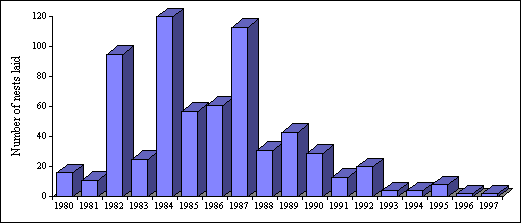
Figure 1. Number of green turtle nests recorded in each year 1980-1997.
Olive ridley nesting at Hawkes Bay and Sandspit was only recorded between the months of March and October with a marked peak between July and September. A total of 654 olive ridley turtle nests were recorded at this site between 1980-1997. During the entire period of study, 42 olive ridley females were tagged and 12 tag returns recorded at the nesting beaches (7 after 1 year; 4 after 2 years and 1 after 5 years). A peak of olive ridley nesting occurred during the 1987 season when 113 olive ridley nests were laid on these beaches. There has however, been a profound decline over the last decade (Figure 2). In each of 1996 and 1997 only 2 olive ridley nests were recorded.
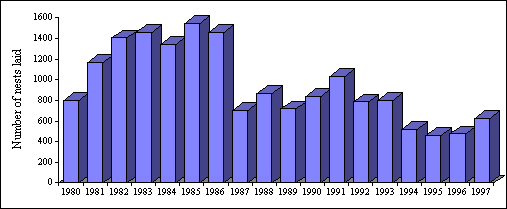
Figure 2. Number of olive ridley nests recorded in each year 1980-1997.
he reasons for the apparent decline in marine turtle populations of both species nesting at Hawkes Bay and Sandspit are not known. However, other than those mentioned above, many threats exist in the region including: beach development, fishing activities, noise from neighbouring villages, pollution from a nearby harbour and exploitation of turtle products. We have not however observed any mass mortality of olive ridley turtles on these beaches as have been found on the Gahirmatha coast of Orissa in India. These data highlight the need to gain a better understanding of marine turtle populations in the region, both on land and at sea, and the importance of regional sea turtle conservation and management programmes.
ASRAR, F.F. 1997. Marine Turtles and CITES in Pakistan. Natura, (WWF, Pakistan) 23 (2): 7-8.
FIRDOUS, F. 1988. Conservation of turtles at Hawkes Bay Sandspit Beaches, Karachi. In: Proceedings of an International Conference on Marine Sciences of the Arabian Sea. MF Thompson and N.M. Tirmizi (Eds.). American Institute of Biological Sciences. pp. 217-222.