seaturtle.org : MTN : ARCHIVES : Sign In
J. Tomás1, J. Castroviejo2 & J.A. Raga1
1 Department of Animal Biology and Cavanilles Research Institute of Biodiversity and Evolutionary Biology, University of Valencia, Dr. Moliner 50, 46100 Burjassot, Valencia, Spain (E-mail: jesus.tomas@uv.es)
2 Estación Biológica de Doñana, CSIC, Avda. M Luisa s/n 41013 Sevilla, Spain
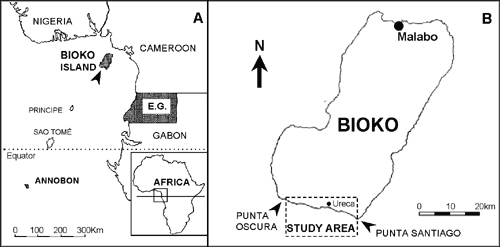
Bioko is the largest of a chain of volcanic islands in the Gulf of Guinea (3° 48' N - 3° 12' N and 8° 25' E - 8° 57' E) (see Figure 1A). The island has 150 km of coastline which is mostly rocky, the only long sandy beaches (totalling 19km) are found on the southern coast (Butynski & Koster 1989). Ureca, a small village of around 100 inhabitants, is the only habitation in this area.
The presence of marine turtles in Bioko has been well documented, although there is little information about nesting population sizes (Brogersma 1982; Butynski & Koster 1989; Castroviejo et al. 1994; Butynski 1996). Four species of marine turtle nest in southern Bioko: the green turtle (Chelonia mydas), the leatherback turtle (Dermocheys coriacea), the olive ridley turtle (Lepidochelys olivacea) and the hawksbill turtle (Eretmochelys imbricata).
Traditionally in this region, these four species have been utilised for food or to make ornamental objects, particularly in the case of hawksbill shell. Urecans eat the meat and eggs of marine turtles, preferring that of green and leatherback turtles and although there has been some trade of turtle products from the past, in recent years this exploitation has been solely for local consumption.
In 1995, Asociación Amigos de Doñana (a Spanish NGO), as a part of the project: "Conservación y Ecodesarrollo del sur de la isla de Bioko", began to work on the beaches of southern Bioko. Biological studies were carried out during two nesting seasons (1996/97 and 1997/98) as a collaborative effort between the NGO and the University of Valencia (Spain), with some local participation. These studies focussed on the threats to turtles in the region, census of individuals and nests, nesting behaviour, nest site selection and hatchling emergence success. This report summarises the threats and nest census data resultant from these studies. More information and details about the study sites can be found in Tomás (1998).
Monitoring was conducted between the 7th October 1996 and the 15th April 1997 and between the 15th September 1997 and the 7th March 1998. Surveys were conducted on approximately 95% of all days, with the beached being patrolled twice each night and once more in the morning.
Table 1 shows the number of activities observed and number of nests per species. The most abundant species recorded was the green turtle, followed by the leatherback. Olive ridley and hawksbill turtles were less common. Although fewer green and hawksbill turtle nests were recorded in 1997/98, a larger number of leatherback and olive ridley turtles were encountered. Turtles of all four species were tagged during both seasons. Furthermore, the table shows the number of turtles tagged and recaptured at least once. No turtles tagged in the season 1996/97 were observed during the 1997/98 season.
Table 1. Results of the seasons 1996/97 and 1997/98. The lasts two columns show the number of tagged turtles recaptured at least once.

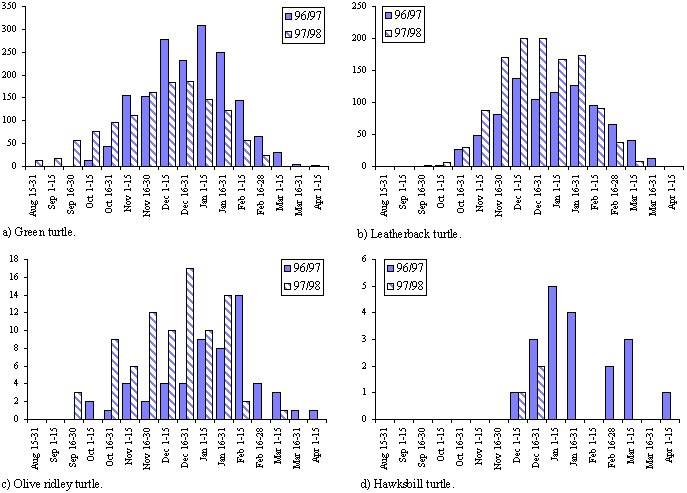
Hirth (1997) stated that less than 500 clutches were laid per season in southern Bioko. In this study we were not able to directly estimate the population sizes due to the low number of repeat encounters of tagged females. However contrary to our initial expectations, southern Bioko is a very important nesting area for both leatherback and green turtles.
Two species of ghost crab (Ocypode spp.) are the most important predators of nests and hatchling in this area. In addition, ants invaded many nests. Other less common predators include; the monitor lizard (Varanus niloticus) and the drill (Papio leucophaeus). Tracks of other mammals, such as the white-tail porcupine (Atherurus africanus) and other unidentified carnivores, were also recorded at nests. Two species of bird, the palm-nut vulture (Gypohierax angolensis) and white crow (Corvus albus), were observed predating hatchlings. Domestic dogs from the village of Ureca were also recorded depredating turtle nests.
Despite the existence of laws to protect the marine turtles, they are still captured in Equatorial Guinea. In 1995, a small reserve was established at Moraca beach, in the west of the study zone. In the two most recent seasons the protection of marine turtles was extended to cover the entire study area, reducing the harvest of marine turtles and their eggs.
Protection of marine turtles at Bioko must include a commitment to community participation and involvement. This should include environmental education and development of alternative sources of income. Protection of these beaches is important in light of the high level and diversity of nesting turtles. Based on these two factors we classify this region as one of the most important marine turtle nesting areas in central Africa.
BRONGERSMA, L.D. 1982. Marine turtles of the eastern Atlantic Ocean. In: K. A. Bjorndal (Ed.) Biology and Conservation of Sea Turtles. Smithsonian Institute Press, Washington D.C. pp. 407-416.
BUTYNSKI, T.M. 1996. Marine Turtles on Bioko island, Equatorial Guinea. Oryx 30(2): 143-149.
BUTYNSKI, T.M. & S.H. KOSTER. 1989. Marine turtles on Bioko Island (Fernando Poo), Equatorial Guinea: A Call for Research and Conservation. Washington DC: WWF Unpublished Report. 14 pp.
CASTROVIEJO, J., J. JUSTE, J. PÉREZ DEL VAL, R. CASTELO & R. GIL. 1994. Diversity and status of sea turtle species in the Gulf of Guinea islands. Biodiversity and Conservation 3: 828-836.
HIRTH, H.F. 1997. Synopsis of Biological Data on the Green Turtle Chelonia mydas (Linnaeus, 1758). Fish and Wildlife Service, U.S. Department of the Interior. Biological Report 97(1): 120pp.
TOMÁS, J. 1998. Estudio de las poblaciones y de la biología de reproducción de las tortugas marinas del sur de Bioko (G.E.). Technical Report. University of Valencia. 17pp.