seaturtle.org :
MTN :
ARCHIVES :
Sign In
Marine Turtle Newsletter 85:2-4, © 1999

Results of the Kemp's Ridley Nesting Beach Conservation Efforts in México
René Márquez1, Juán Díaz1, Manuel Sánchez1, Patrick Burchfield2, Alma Leo1, Miguel Carrasco1, Jaime Peña2, Carmen Jiménez1, Rafael Bravo1
1Instituto Nacional de la Pesca, Programa Nacional de Investigación de Tortugas Marinas, México, A.P. 591, Manzanillo, Col. México 28200 (E-mail: rmarquez@bay.net.mx)
2Gladys Porter Zoo, 500 Ringgold St., Brownsville, Texas, USA 78520
Based on an amateur film by Andrés Herrera in 1947, Hildebrand (1963) and Carr (1963) estimated that 40,000 Kemp's ridley turtles (Lepidochelys kempi) nested in one day in June at Rancho Nuevo, Mexico. The methods of estimation have recently come into question, however during the 1960's there were arribadas that easily surpassed 2,000 nesting turtles (Márquez 1994).
As a result of concerns as to the status of the species, intensive monitoring of Kemp's ridley turtle nesting and associated conservation efforts on Mexican beaches started in 1966 with the installation of the first camp in Barra de Calabazas, Rancho Nuevo, Tamaulipas, México (Figure 1). This site was central to the beaches most densely nested by Kemp's ridley turtles. A portion of this beach was designated a "Natural Reserve" in 1977 (Diario Oficial 1977), incorporating 15 km of coastline and a 4 km offshore zone which is closed to commercial fisheries during the marine turtle breeding season.
Prior to 1977, patrolling to tag turtles, undertake nest counts and additional data collection was limited to 25 km of beach. Between 1978 and 1989, after obtaining all terrain vehicles, the area patrolled was extended and, as a result, the proportion of nests recorded and protected was increased. In 1990, the project continued to expand and another camp at Tepehuajes/Ostionales was created bringing the area of beach surveyed to 45 km. In 1991, the 10km beach south of Barra del Tordo (Figure 1) was also included in the study. Between 1992 and 1996, the area patrolled was further increased to 120 km through the establishment of several new camps and since 1997, other nesting beaches in the State of Veracruz have been included, increasing the protected area to over 200 km. At a number of these sites small yet significant numbers of Kemp's ridley nests were recorded in 1998: Altamira (199 nests); La Pesca (40 nests); Miramar (15 nests); Lechuguillas (82 nests); Los Coyoles (25 nests); El Llano (12 nests) and El Laurel (21 nests). There are also records of scattered nesting in places such as: Cabo Rojo and Tecolutla, Veracruz, Isla Aguada, Campeche, and Padre Island, Texas (Márquez 1994).
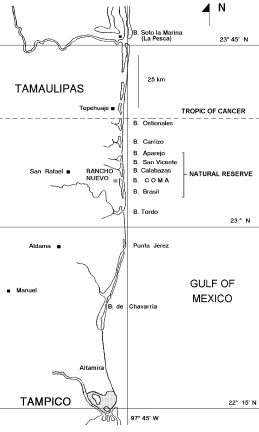
Figure 1. Kemp's ridley nesting sites, Tamaulipas, México
Despite two decades of effort, between 1985 and 1987 the annual number of nests recorded along 30 km at Rancho Nuevo, reached the lowest on record; 740, 752 and 742 nests, respectively. Soon after the annual number of nests slowly started to increase (Figure 2) to a maximum of 2409 nests in 1998. In the same season, a similar trend was also observed at Barra del Tordo (431 nests) and Barra de Tepehuajes (642 nests) (Figure 3).
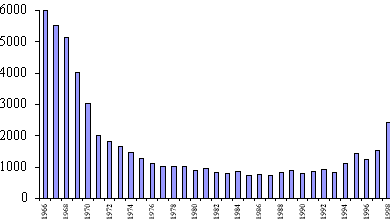
Figure 2. Kemp's ridley turtle nesting at Rancho Nuevo beach, Tamaulipas, México.
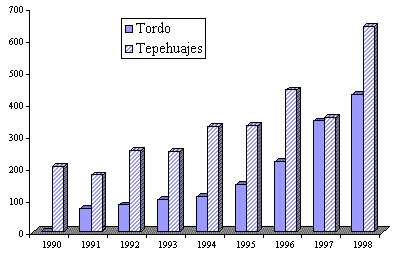
Figure 3. Kemp's ridley turtle nesting in Tepehuajes and Barra del Tordo beaches, in Tamaulipas, México.
The mean annual increase in nesting at Rancho Nuevo between 1988 and 1998 is 8%, however when all three sites are considered, the annual increase is 12%. This gradual increase in nesting numbers that appears to have begun in the early 1990's is likely to be the result of a combination of a number of activities. These may include an increase in recruitment to the population as a result of beach and nest protection at Rancho Nuevo and neighbouring camps and the introduction of Turtle Excluder Devices.
Acknowledgements: Since the start of this project, it has involved the collaboration of many researchers, students and voluntary workers. US Institutions such as US Fish & Wildlife Service, National Marine Fisheries Service and National Parks Service have been important to the programme. The Mexican Universities, State organizations, Fisheries Inspectors, Mexican Navy, NGO's, ProFePa, Rancho Nuevo community, Scouts, PEMEX, have together contributed to the recovery of this species.
CARR, A., 1963. Panspecific reproductive convergence in Lepidochelys kempi. Ergebnisse der Biologie, 26:298-303.
DIARIO OFICIAL, 1977. "Acuerdo que establece la Zona de Refugio y Veda para la protección de la Tortuga Lora". Departamento de Pesca. Diario Oficial de la Federación. México, Julio 4, 1977, 5pp.
HILDEBRAND, H., 1963. Hallazgo del área de anidación de la tortuga "lora" Lepidochelys kempii (Garman), en la costa occidental del Golfo de México (Rept., Chel.). Ciencia, Mexico, 22(4):105-112.
MÁRQUEZ M.R., 1994. Sinopsis de datos biólogicos sobre la tortuga lora, Lepidochelys kempi (Garman, 1880) Instituto Nacional de la Pesca, México/FAO Sinopsis. SAST-Tortuga Lora 5.31(07) 016.02, INP/S152:141.