seaturtle.org :
MTN :
ARCHIVES :
Sign In
Marine Turtle Newsletter 98:1-2, © 2002

Preliminary Check-List of the Epizootic Macroalgae Growing on Loggerhead Turtles in the Western Mediterranean Sea
José C. Báez1, Juan A. Camiñas2, Julio Valeiras2, Francisco Conde1 & Antonio Flores-Moya1
1Departamento de Biología Vegetal, Facultad de Ciencias, Universidad de Málaga, Campus de Teatinos s/n, E-29071 Málaga, Spain (E-mail: floresa@uma.es)
2Instituto Español de Oceanografía(IEO), Centro Oceanográfico de Málaga, Puerto pesquero s/n, E-29640 Fuengirola (Málaga), Spain (E-mail: jacaminas@ma.ieo.es)
There have been several studies on the epibionts of nesting loggerhead turtles, Caretta caretta. To date, we are only aware of six papers which cite algae as epibionts of loggerhead turtles (reviewed by Dodd 1988). Abel Sentíes et al. (1999) reported 37 species growing on loggerhead turtles found off the Caribbean coast of Mexico. Recently, Frick et al. (2000) found 7 new species of epibionts of the loggerheads nesting in Georgia, USA, among them a green plume alga, Bryopsys plumosa.
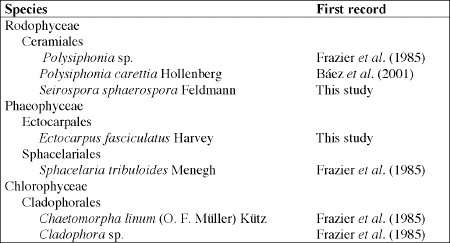
Table 1. Preliminary checklist of macro algal species recorded on loggerhead turtles in the western Mediterranean Sea. The study which first documented the species is given.
It has been proposed that the western Mediterranean Sea contains loggerhead turtles from two discrete nesting populations: 1) the southeastern USA/Gulf of Mexico and 2) the eastern and central Mediterranean Sea (Margaritoulis 1982; Márquez 1990). Genetic (Bowen et al. 1993; Laurent et al. 1993), tagging-recapture (Bolten et al. 1992; Manzella et al. 1988) and fisheries-based studies (Camiñas 1992; 1995; Camiñas & Serna 1995) have probed the dual origin of these loggerhead turtles.
The area surrounding the Balearic Islands is considered an important loggerhead feeding area, particularly during spring and summertime (Camiñas 1997). The Spanish longline fleet incidentally captures large numbers of loggerhead turtles, and during 1998-2002 the Spanish Institute of Oceanography (IEO) conducted an onboard observer programme of this fishery. Complementary to this activity, a study of the loggerhead epibiotic algae was undertaken. During the onboard period a total 131 samples of algae were obtained and preserved from the 676 loggerhead turtles captured. The incidence of algae on the loggerhead was 64 % in 1999 and 69.1 % in 2000. The analysis of the total 131 samples is underway.
Our study compliments three previous studies in the region (Báez et al. 2001; Frazier et al. 1985, Gramentz 1988). The epizoic macroalgae growing on loggerhead turtle in the western Mediterranean Sea are shown in Table 1. The algae we found growing on loggerhead turtles were small and filamentous (Báez et al. 2001). To date only 5 species and 2 taxa (these only to level of genus) have been recorded on Mediterranean loggerheads. This is in contrast to 33 species and 4 taxa described in Abel Sentíes et al. (1999) for the loggerhead from the western Atlantic Ocean. These are the first records of Seirospora sphaerospora and Ectocarpus fasciculatus growing on loggerhead turtles.
The implications of the presence of Polysiphonia carettia on the biogeography of loggerhead turtles in the Northern Hemisphere has been discussed in Báez et al. (2001). The authors investigated the possibility of using Polysiphonia carettia as a biological marker to distinguish the loggerheads that come from the Atlantic Ocean to those coming from the eastern Mediterranean Sea. Additional studies on Polysiphonia distribution are underway to test this hypothesis.
Acknowledgements: We are grateful for the constructive review of two anonymous referees.
ABEL SENTÍES, G., J. ESPINOZA-AVALOS & J.C. ZURITA. 1999. Epizoic algae of nesting sea turtles Caretta caretta (L.) and Chelonia mydas (L.) from the Mexican Caribbean. Bulletin of Marine Science 64: 185-188
BÁEZ, J. C., J. A. CAMIÑAS, J. VALEIRAS, F. CONDE & A. FLORES-MOYA. 2001. First record of the epizoic red seaweed Polysiphonia carettia Hollenberg in the Mediterranean Sea. Acta Botánica Malacitana 26: 197-201.
BOLTEN A.; H. MARTINS; K.A. BJORNDAL; M. COCCO; G. GEROSA, 1992. Caretta caretta (Loggerhead) pelagic movement and growth. Herpetological Review 23: 1
BOWEN B.; J.C. AVISE; J.I. RICHARDSON; A.B. MEYLAN; D. MARGARITOULIS; S.R. HOPKINS-MURPHY, 1993. Population structure of Loggerhead Turtles (Caretta caretta) in the Northwestern Atlantic Ocean and Mediterranean Sea. Conservation Biology 7: 834-844.
CAMIÑAS J.A. 1992. Hipótesis migratoria de la tortuga boba (Caretta caretta) en el Mediterráneo occidental a partir de datos procedentes de pesquerías de superficie. 1er Congreso Nacional de Reptiles Marinos. Begur 22-23 Octubre de 1992. (Gerona).
CAMIÑAS J.A. 1995. The loggerhead Caretta caretta (Linnaeus, 1758) pelagic movements through the Gibraltar Strait. Rapport et Procès-Verbaux des Reunions. Commision Internationale pour l’exploration scientifique de la Mer Méditerranée Vol. 34: 238
CAMIÑAS, J. A. 1997. Capturas accidentales de tortuga boba Caretta caretta (Linnaeus, 1758) en el Mediterráneo occidental en la pesquería de palangre de superficie de pez espada (Xiphias gladius L.). International Commission for the Conservation of Atlantic Tunas. Collective Volume of Scientific Papers XL VI : 446-455
CAMIÑAS, J.A. & J.M. de la Serna. 1995. The loggerhead distribution in the western Mediterranean Sea as deduced from captures by the Spanish long line fishery. In: Llorente et al. (Eds.). Scientia Herpetologica 1995: 316-323
DODD, C.K. Jr., 1988. Synopsis of the biological data on the loggerhead sea turtle Caretta caretta (Linnaeus 1758). US Fish and Wildlife Service Biological Report 88, 110pp.
FRAZIER, J., D. MARGARITOULIS, K. MULDOON, C.W. POTTER, J. ROSEWATER, C. RUCKDESCHEL, & S. SALAS. 1985. Epizoan communities on marine turtles: I Bivalve and Gastropod molluscs. Marine Ecology 6: 127-140.
FRICK, M.G., K.L. WILLIAMS, D. VELJACIC, L. PIERRARD, J.A. JACKSON AND S.E. KNIGHT. 2000. Newly documented epibiont species from nesting loggerhead sea turtles (Caretta caretta) in Gergia, USA. Marine Turtle Newsletter 88:3-5
LAURENT L., J. LESCURE, L. EXCOFFIER, B. BOWEN, M. DOMINGO, M. HADJICHRISTOPHOROU, L. KORNARAKI, G. TRABUCHET. 1993.- Étude génétique des relations entre les populations méditerranéenne et atlantique d’une tortue marine (Caretta caretta) à l’aide d’un marqueur mitochondrial (1993). Complis Rendus Academie Scinces Paris, Sciences de la vie 316: 1233-1239.
MANZELLA , S.A., C.T. FONTAINE AND B.A. SCHROEDER. 1988. Loggerhead sea turtle travels from Padre Island, Texas to the mouth of the Adriatic Sea. Marine Turtle Newsletter 42:7-7.
MARGARITOULIS, D. 1982. Observations on loggerhead sea turtles (Caretta caretta) activity during the nesting seasons (1977-1979) in Zakynthos, Greece. Biological Conservation 24: 193-204.
MÁRQUEZ, M. R. 1990. FAO Species catalogue. Sea turtles of the world. An annotated and illustrated catalogue of sea turtle species known to date. FAO Fisheries Synopsis, 125. Rome, FAO. Vol.: 11, 81 pp.