


Cordii
Exploring Albatross Movements - 2008
A project of Albatross Conservation Collaborative.
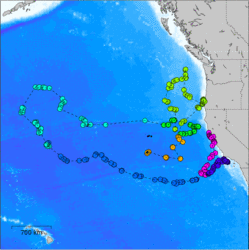 click map for full-size version Movements of a Black-footed Albatross equipped with a satellite-linked transmitter programmed to operate on a 60-second repetition rate for 6 hours (noon - 6 pm, California time) every day. Only good quality locations (classes 1, 2, 3, 0) are shown as connected filled circles, with the color indicating the timing of the location. Poor quality locations (classes A, B) are shown as black dots.
|
Full-Size Map (72KB)
Zoom Map (105KB)
Species: Black-footed Albatross
Life Stage: Sub-Adult (Plumage 2+)
Gender: Unknown
Release Date: 2008-08-05 21:15:00
Release Location: Cordell Bank
Last Location: 2008-10-15 00:49:09
Background
Because the name of this albatross (CORDII) is a combination of Cordell and Hawaii, it links these two sites and reminds people that this is a bird of both places. Submitted by Bob Wilson, GFNMS volunteer.
Cordii stopped transmitting after 71 days, well beyond the expected 55-day life-span of the single AA battery. This is the second longest deployment, after the 74-day record set by Ibn-Battuta. The transmitter sensor data indicated that the voltage dropped before transmissions ceased, suggesting that the battery had been exhausted.
