Current Projects
Ascension Island
Darwin-Gabon
Northern Cyprus
Satellite Tracking
Completed Projects
Darwin-Anegada
Darwin-Cayman
Guinea Bissau
Little Cayman
TCOT
TUKOT

Using satellite telemetry to determine post-nesting migratory corridors and foraging grounds of green turtles nesting at Poilão, Guinea Bissau:
Sponsors:
 |
 |
 |
The project sponsors were Convention on Migratory Species, Fondation Internationale pour Banc D'Arguin and People's Trust for Endangered Species. All labour costs for the project in Guinea Bissau, Portugal and UK were given in kind.
Implementing Organisations:
- Marine Turtle Research Group
- Gabinete De Planificação Costeira (GPC)
- UICN , Guinea-Bissau
- Instituto Nacional de Estudos e Pesquisas (INEP)
- Centro de Investigação Pesqueira Aplicada (CIPA)
- Unidade de Investigação em Eco-Etologia, ISPA – Instituto Superior de Psicologia Aplicada, Portugal
Introduction
Poilão, a small uninhabited island in the Bijagós Archipelago, Guinea Bissau is the most important nesting aggregation of green turtles (Chelonia mydas) in the eastern Atlantic. Limited information gathered regarding the nesting at this site suggests several thousand females nest there each year. For more information see online article in Marine Turtle Newsletter.
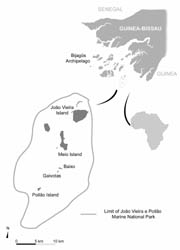 Location of Poilao |
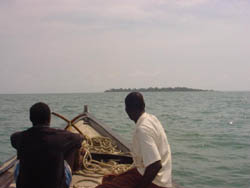 Arrival by boat |
|---|
 Aerial view of nesting beach |
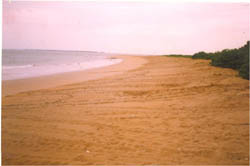 High density nesting |
|---|
The size of the rookery, and its relative isolation and current level of protection mandate the further investigation of the distribution pattern of its turtles outwith the breeding season. As a result a team was assembled to allow the satellite tracking of 10 individual turtles from the nesting ground at Poilao.
Personnel and Fieldwork
The planning team consisted of:
Castro Barbosa BSc (Researcher at the Coastal Planning Office, Bissau)Annette Broderick PhD (Post-doctoral research scientist; Marine Turtle Research Group)
Paulo Catry PhD (Technical Assistant, IUCN Guinea-Bissau)
Brendan Godley PhD (Post-doctoral research scientist; Marine Turtle Research Group)
Graeme Hays PhD (Senior Lecturer, University of Wales, Swansea)
Fieldwork was carried out between 17th November and 2nd December 2001. Drs. Godley and Catry with the UICN and the consortium of individuals and organisations (GPC, INEP, CIPA, RBABB) which undertake the ongoing turtle monitoring and conservation work. The project team (photo by Dr. Godley) is shown below. All team-members were trained in the principles of satellite telemetry and the attachment of telemetry units.
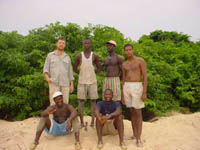
Back Row: Paulo Catry (UICN, ISPA), Januário da Silva (Canhabaque), Preto João Perrida (Canhabaque), Amadeu Almeida (CIPA),
Front Row: Castro Barbosa (GPC), Bucar Indjai (INEP).
The telemetry units used were Telonics ST-18 and ST-6. Ten units were attached
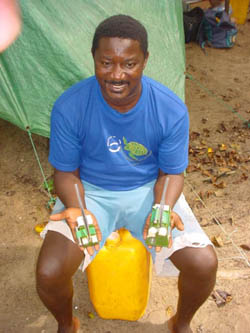 Telonics ST-6 and ST-18 units used |
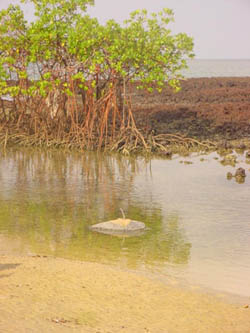 Turtle in intertidal pool awaiting rising tide |
|---|
Outputs
The final report of this project is available as a pdf which details some the outputs of this project. In addition scientific papers will be produced for submission to peer-reviewed journals. Anyone who would like to be on the circulation list for reprints of these papers subsequent outputs of this project should contact:
Marine Turtle Research Group,
Centre for Ecology and Conservation
University of Exeter in Cornwall
Tremough Campus
Penryn TR10 9EZ UK
https://seaturtle.org/mtrg/
MTRG@seaturtle.org
Acknowledgements
Besides the essential contributions of the donors, this project as benefited from the support of many individuals and institutions. We would particularly like to acknowledge the support given by Pierre Campredon (FIBA), Nelson Gomes Dias (IUCN – Bissau), Alfredo Simão da Silva (GPC), Justino Biai and the staff from the Bijagós Biosphere Reserve as well as all the staff from the Orango National Park that were involved in one way or another. This work would not have been possible without the support of the people from the village of Ambeno (island of Canhabaque), the traditional owners of the sacred island of Poilão. Thanks to Michael Coyne of seaturtle.org for producing the website.